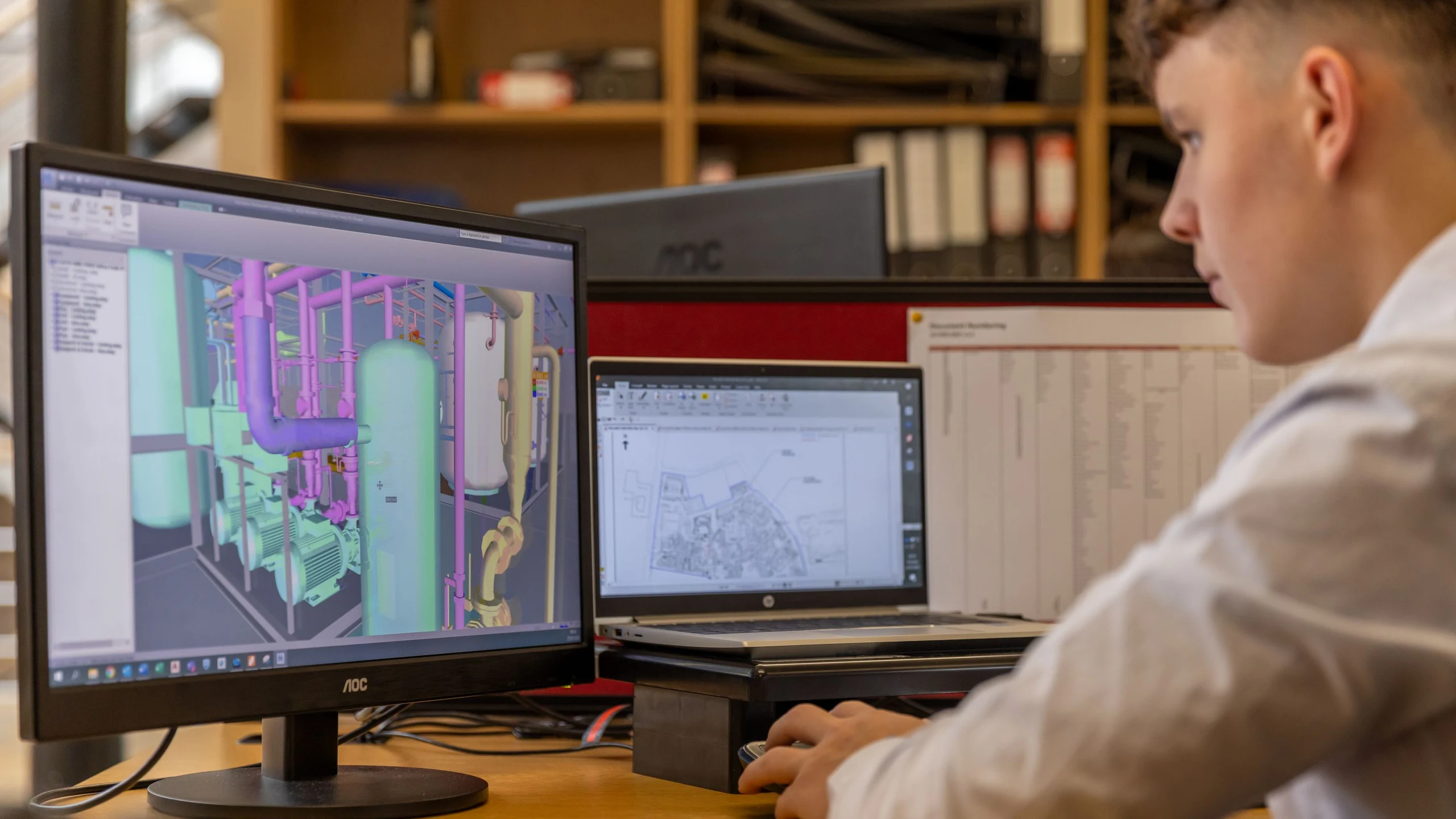
Engineer reviews a three dimensional piping and equipment model on a monitor beside a laptop.

Digital Twins and Simulation

Digital experiments can expose unsuitable behavior before a broader physical trial, provided their assumptions and limits are understood. This program studies calibrated models, repeatable simulation environments, and evidence of transfer to real equipment. Its focus is whether a model is credible for a defined question, rather than how realistic a visualization appears.

Establish What a Digital Experiment Can Support

A model can reproduce one operating condition yet miss an important response under another. Timing delays, changing loads, imperfect observations, and simplified equipment dynamics can alter the result. A digital experiment therefore needs a stated purpose, documented inputs, and a clear account of where its predictions have been compared with physical evidence.

Consider a proposed pump-system study comparing a baseline controller with a candidate policy. A calibrated model could examine changing demand and delayed observations. Subsequent measurements from an approved physical setup would test whether predicted flow, pressure, and response timing remain useful. Disagreement would guide model revision or restrict its intended use. This example is proposed, not a reported Aperture experiment.

Research Areas

Operational Digital Twins

Investigate digital representations connected to a defined physical asset or process through relevant data and updating procedures. Research questions include state synchronization, model revision, provenance, and suitability for a particular operational decision. A static geometry model or dashboard alone does not establish an operational twin. The required connection and update frequency depend on the intended use.

Simulation to Reality Transfer

Examine how conclusions from a digital environment hold up on physical equipment. Candidate methods include calibration, sensitivity analysis, parameter variation, and tests outside the conditions used to fit a model. Calibration can improve agreement with selected observations; independent validation is still needed. Unmodeled effects and differences in timing or interfaces should remain visible in the transfer evidence.

Hardware in the Loop Testing

Connect real controller hardware to a simulated process through defined input and output interfaces. This can expose implementation timing, communication, and integration issues that a software-only test may miss. The simulated process still has limits, and interface scaling, synchronization, and delays require examination. A hardware test with simulated equipment does not establish full physical plant performance.

Methods and Evaluation

Assess credibility for a defined use

A proposed study would state its question, baseline, model version, assumptions, reference measurements, and test conditions. Verification checks defined implementation properties; validation assesses agreement with physical evidence for the intended use. NIST research identifies verification, validation, and uncertainty quantification as important to digital twin credibility. Keep calibration data separate from validation evidence and retain discrepancies alongside successful comparisons.

Candidate evaluation measures

Measures may include prediction error, timing mismatch, uncertainty interval coverage, repeatability, synchronization delay, and the difference between simulated and measured outcomes. Report the operating range, sample scope, reference uncertainty, and excluded conditions. Acceptance thresholds require technical approval. A strong fit on one dataset should not be presented as evidence of suitability across machines, sites, or tasks.

Current Stage and Research Limits

This overview presents the program’s research agenda. It does not claim that Aperture has implemented a twin, owns a test facility, or has completed transfer studies or physical trials. Approved project records should distinguish digital experiments, hardware interface tests, physical testbeds, and supervised pilots, with dated methods, findings, limitations, and next steps.

This program owns model fidelity, simulation environments, and transfer evidence. Control and robot policies remain with the programs developing them. Digital evidence supports a bounded evaluation; it does not independently establish deployment readiness, certification, or successful physical operation.

Explore Specialist Research or Propose a Study

Visit Aperture Simulation Labs for detailed program research. To discuss a study, describe the physical process, decision to evaluate, model and data available, expected operating range, and physical evidence accessible for comparison. Begin with a nonconfidential summary.

All Research Programs
Scroll to Top