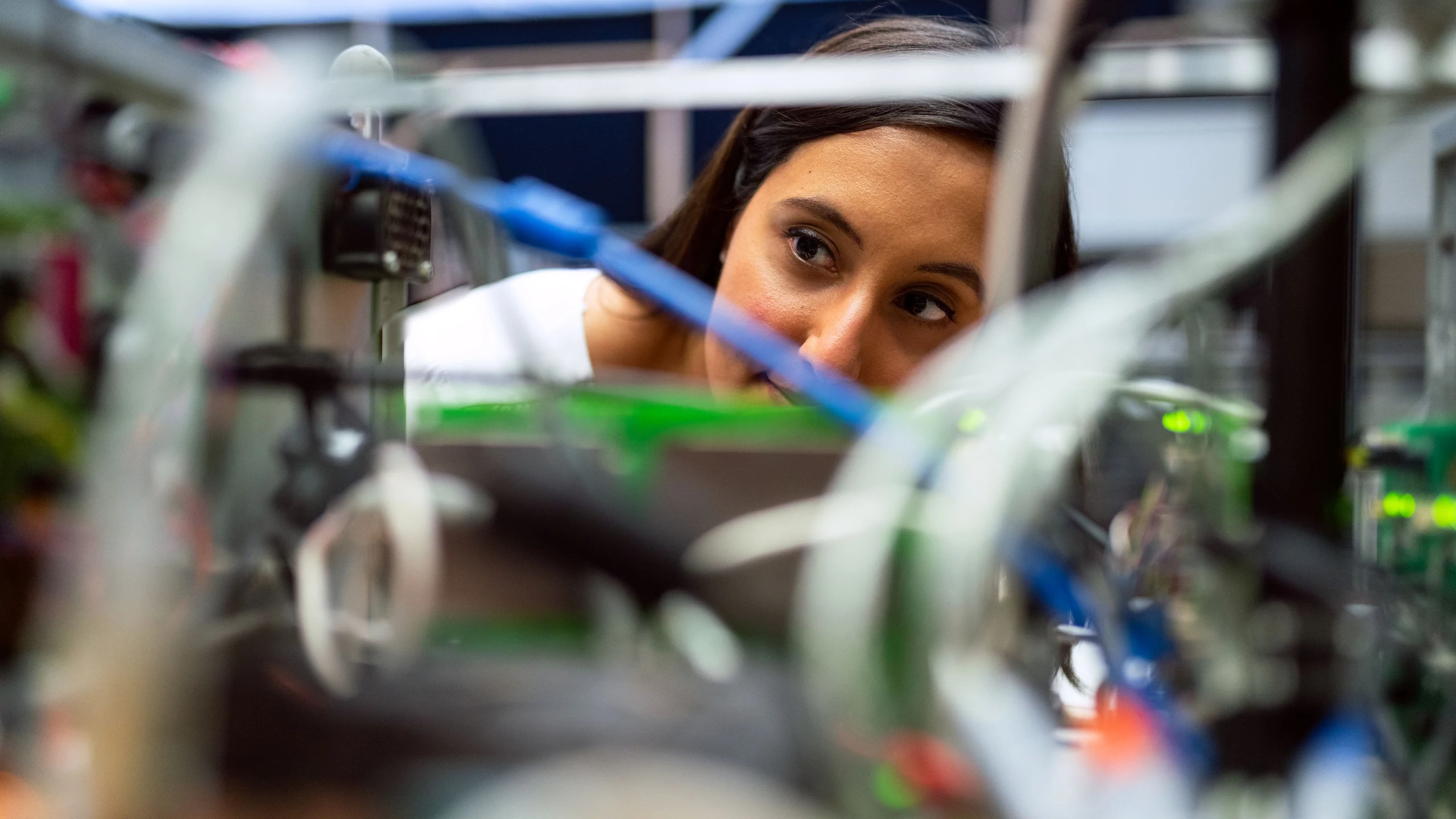
Engineer examines an instrumented assembly through cables and metal framing in a research workshop.

Identification and Sensing

Dependable industrial decisions begin with a defensible account of what is present, where it is, and what condition it is in. This program addresses how imperfect observations can support physical state estimation without hiding uncertainty, missing evidence, or changes over time.

Establish Physical Context Before Using It

A tag detection does not always establish an exact position. A valid measurement can describe the wrong asset, and a previously useful reading may become stale before another system receives it. Identification and Sensing brings these questions together: entity identity, location, condition, observation quality, and operational context.

Consider a reusable container moving between production stations. An identifier may be observed near one station while a delayed position update points elsewhere. A proposed study would preserve both observations, their timing, and their limitations, then evaluate whether the available evidence supports a location estimate or requires an unknown state. This is an illustrative research question, not a reported experiment.

Research Areas

Identification and Localization

Investigate how identifiers and position observations can be associated with the correct physical entity. Research questions include duplicate detections, ambiguous read zones, transitions between locations, and continuity when observations are interrupted. The relevant output may be a confirmed zone, an estimated position, or an unresolved association rather than a single precise coordinate.

Sensor Reliability and Data Quality

Examine calibration, timing alignment, missing data, drift, and conflicting measurements. Calibration and traceability need to be considered alongside uncertainty and suitability for the measurement task; traceability alone does not guarantee fitness for purpose. The research scope includes detecting degraded observations and preserving enough provenance to inspect how a state estimate was formed.

World State Grounding for Physical AI

Grounding connects a digital representation to evidence about physical entities and conditions. This area examines how identity, location, condition, and time can be represented together, including freshness and uncertainty. Event models such as GS1 EPCIS provide a reference for sharing asset observations with contextual information; a structured event does not itself establish that an observation is correct.

Methods and Evaluation

Compare estimates with independent evidence

A proposed evaluation would define the task, reference measurements, baseline, and operating conditions before testing. Recorded observation replay could support repeatable comparisons, followed by physical tests where justified. Reference uncertainty and timing alignment should be documented. Tests should include interrupted observations and changed conditions, with failures retained alongside successful cases.

Candidate evaluation measures

Measures may include correct identity association, missed and false detections, position error or zone accuracy, observation latency, stale-state duration, and recovery after an interruption. Where estimates express confidence, evaluation should check whether that confidence matches observed error. Report the sample scope and uncertainty; numerical thresholds require technical approval for the intended task.

Current Stage and Research Limits

The program scope presented here is a research agenda. This overview makes no claim of a completed experiment, demonstrated testbed, supervised pilot, or deployed system. Project-specific records should identify the stage actually reached, dated findings, setup, limitations, and next steps once approved evidence is available.

Measurement quality and physical state estimation are this program’s responsibility. They support downstream research, but do not determine which operational action should be taken, diagnose every equipment fault, or establish protection against an adversary.

Explore Specialist Research or Discuss a Question

Visit Aperture Identification and Sensing Labs for detailed program research. To discuss a challenge, describe the physical entity, observations available, operating environment, uncertainty that matters, and outcome you need to evaluate. Begin with a nonconfidential summary.

All Research Programs
Scroll to Top