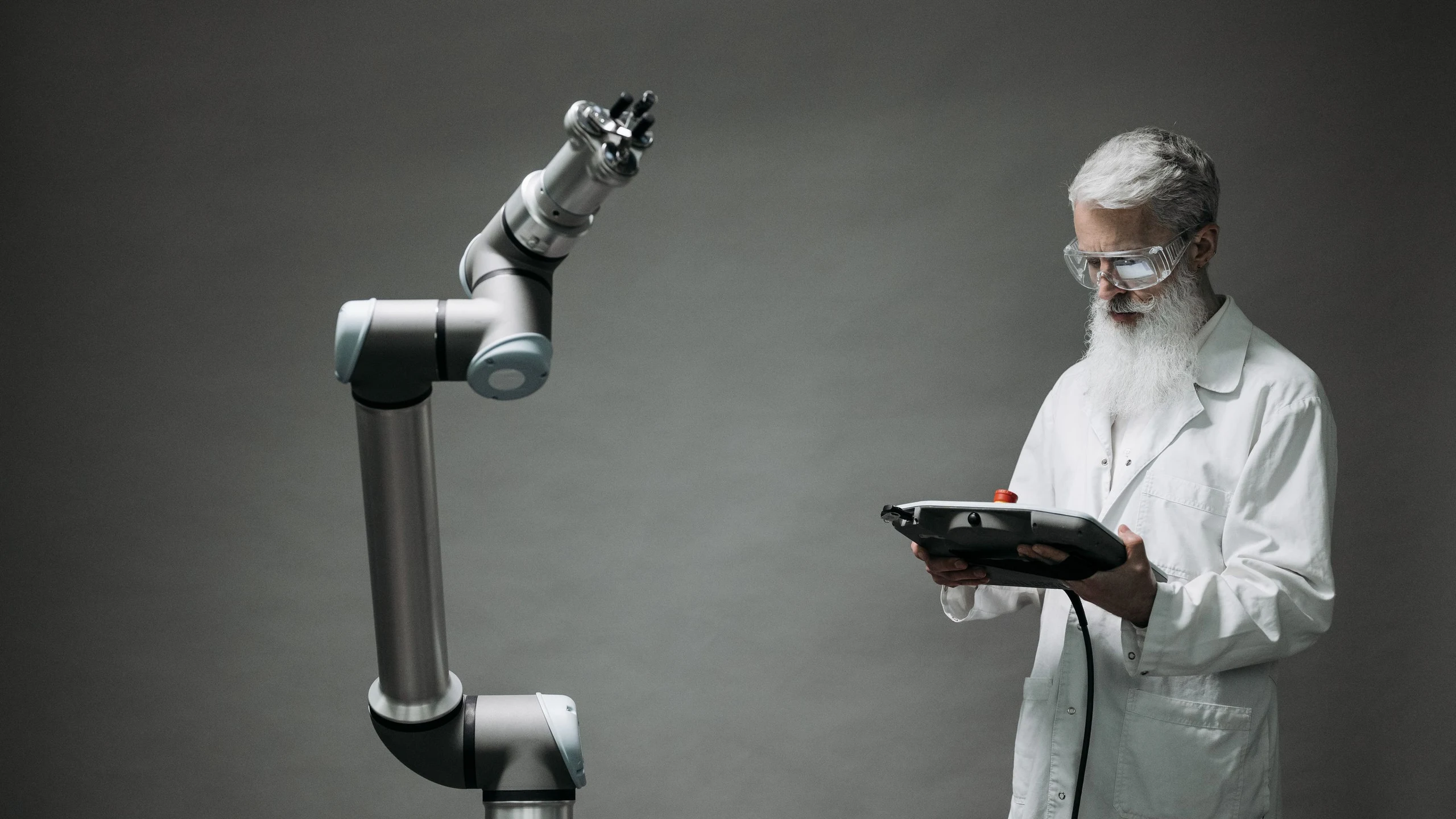
Researcher examines a robotic arm and its control equipment in a laboratory research setting.

Robotics and Distributed Intelligence

Industrial robots need to interpret their surroundings, select suitable behavior, and complete physical tasks under changing conditions. This program studies perception, planning, manipulation, and coordination for robots, drones, and vehicles. It examines both individual platform autonomy and the behavior that emerges when several devices share information, space, and responsibilities.

Evaluate the Task in Its Operating Context

A successful grasp does not establish reliable handling across different parts. A vehicle reaching a waypoint does not establish effective coordination with another platform. Industrial research must define the task, environment, equipment, and allowed behavior before judging capability. NIST robotics work uses task-related measurements to examine perception, mobility, manipulation, and collaborative performance.

Consider a proposed material-transfer study involving a mobile vehicle and a stationary robot arm. The vehicle would deliver a container to a handoff area, and the arm would transfer a part after checking readiness. Trials could examine interrupted communication, varied arrival positions, and blocked access. Independent observations would assess completion and recovery. This is an illustrative study, not a demonstrated Aperture system.
Research Areas

Edge and Distributed Intelligence

Investigate which decisions belong on a robot, a nearby computing device, or a shared coordination service. Questions include response latency, local state availability, synchronization, and behavior when a connection is interrupted. Local processing can reduce dependence on remote communication for some tasks, but does not by itself establish safe or reliable autonomy.

Robot Learning and Manipulation

Study how robots perceive objects, plan motion, and learn or adapt physical handling behavior. Research questions include variation in object appearance and pose, limited demonstrations, grasp uncertainty, and recovery after unsuccessful contact. Learned policies need evaluation beyond their training examples, with explicit limits on the objects, operating conditions, and task variations covered by the evidence.

Mixed Fleet Coordination

Examine task allocation, shared routes, handoffs, and interaction among platforms with different capabilities and interfaces. A fleet may include vehicles, manipulators, or inspection platforms, but coordination requirements depend on the actual task. Proposed methods should account for stale status, competing priorities, unavailable equipment, and recovery without assuming that every device shares one controller or a continuously available network.

Methods and Evaluation

Measure behavior across complete task sequences

A proposed evaluation would define a task sequence, baseline, independent reference observations, and permitted operating conditions. Simulation could support repeatable scenario comparisons before supervised physical tests where justified. Record preparation, execution, handoff, failure, intervention, and recovery. Vary relevant objects, routes, loads, or communication conditions so that a successful nominal run is not mistaken for broader capability.

Candidate evaluation measures

Measures may include task success, grasp or placement error, cycle time, route completion, handoff failures, coordination delay, recovery time, and human intervention frequency. Report failures and excluded scenarios alongside averages, with sample scope and uncertainty. Fleet throughput should be considered separately from individual robot performance. Numerical thresholds and protective arrangements require technical approval for each proposed test.

Current Stage and Research Limits

This overview presents a research agenda. It does not claim that Aperture owns a robot fleet, operates a test facility, or has completed robot learning trials or supervised pilots. Approved project records should distinguish simulated behavior from physical measurements and state the dated setup, findings, limitations, and next steps.

The program owns platform autonomy and fleet behavior. Supporting localization, simulation infrastructure, assurance, and security remain with their respective programs. A task demonstration is evidence only for its stated conditions and does not establish unrestricted autonomy, certification, or suitability across industrial sites.

Explore Specialist Research or Propose a Task

Visit Aperture Autonomy Labs for detailed program research. To discuss a task, describe the platforms, physical environment, objects or loads, available observations, coordination requirements, and outcome to evaluate. Begin with a nonconfidential summary.

All Research Programs
Scroll to Top