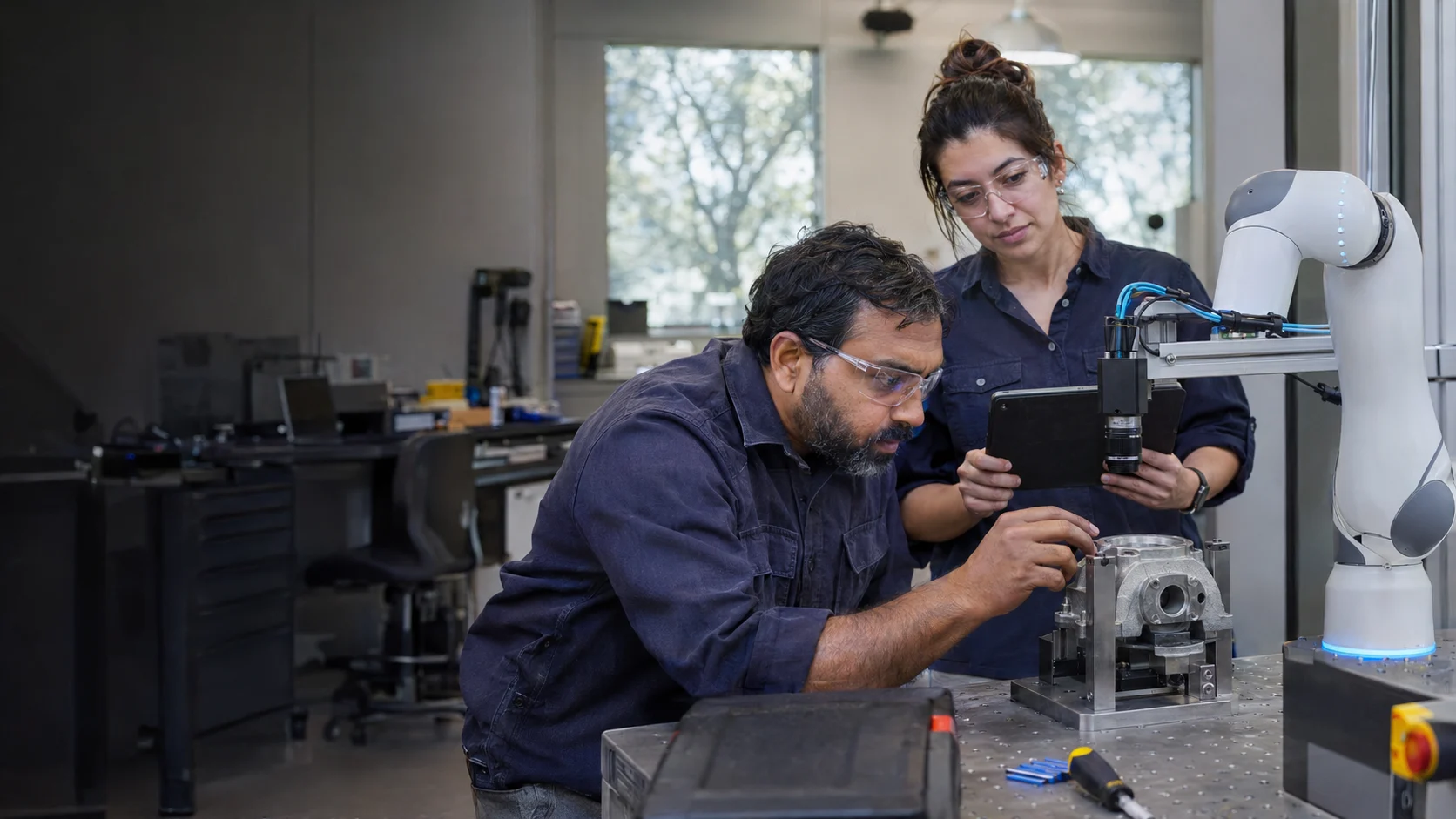
Engineer using a laptop beside instrumented equipment, wiring, and a test assembly in a workshop.
Aperture Physical AI Research Labs

From Physical Intelligence to Trusted Action

Aperture Physical AI Research Labs develops industrial systems that identify, sense, decide, and act.

Our research agenda connects eight complementary programs around a shared question: how can industrial systems use physical evidence to support decisions and actions within defined limits? This hub introduces the programs, shared methods, and proposed research priorities. Project-specific activity and results will be presented with their confirmed stage and evaluation conditions.

Research grounded in industry

Research grounded in industrial problems

Industrial decisions depend on observations that may be incomplete, delayed, or inconsistent. Equipment behavior changes, operating constraints vary, and an instruction that appears reasonable in software may produce a different physical response. Our research agenda addresses these gaps across measurement, diagnosis, control, robotics, and deployment, with attention to operator needs and the evidence required to judge an outcome.

Eight complementary programs

Explore our research programs

Each program addresses a distinct part of the industrial problem. The hub connects shared methods and cross-program questions; specialist websites provide the detailed program research.

01

Identification and Sensing

Establish dependable identity, location, condition, and operational context from imperfect observations. Research areas include identification and localization, sensor reliability, and physical state estimation. The program addresses measurement validity and uncertainty so downstream systems can distinguish a useful observation from missing, stale, or conflicting evidence before using it to support an operational decision.

Explore This Program
02

Equipment Health and Quality

Investigate equipment deterioration, production defects, and likely causes of abnormal behavior. Research areas include predictive maintenance, multimodal inspection, quality prediction, and root cause analysis. The program focuses on diagnostic and quality inference, connecting findings to maintenance questions while keeping measurement validity and decisions about process intervention within their respective programs.

Explore This Program
03

AI Decisions and Control

Translate operational intent into decisions and actions within defined limits. Research areas include industrial AI agents, constrained planning, process optimization, and building and energy control. The program examines command preconditions, permitted actions, and measured responses, with attention to existing control systems and the circumstances that require a stop, fallback, or human decision.

Explore This Program
04

Digital Twins and Simulation

Use calibrated models and repeatable digital experiments to examine behavior before broader physical testing. Research areas include operational digital twins, simulation to reality transfer, and hardware in the loop testing. The program addresses model fidelity and transfer evidence, making assumptions and mismatches visible when interpreting what a digital result can establish about physical equipment.

Explore This Program
05

Robotics and Distributed Intelligence

Study perception, planning, manipulation, and coordination for industrial robots, drones, and vehicles. Research areas include robot learning, intelligence distributed across devices, and mixed fleet coordination. The program focuses on platform autonomy and fleet behavior, working with related programs on localization, simulation, oversight, and security when those capabilities are needed for a defined task.

Explore This Program
06

Assurance Oversight and Connectivity

Develop methods for checking whether decisions and actions remain within stated limits. Research areas include runtime assurance, outcome evaluation, human intervention, and behavior under communication failures. The program considers operator workload and the information needed to intervene, while distinguishing general assurance questions from adversarial security threats and the design of control policies themselves.

Explore This Program
07

Security and Trusted Industrial AI

Examine threats to industrial observations, AI decisions, command interfaces, and physical outcomes. Research areas include sensor spoofing resistance, secure agents and commands, privacy, resilience, and recovery. The program focuses on adversarial threat models and security controls, including how compromised information or unauthorized instructions could affect a physical process under a defined operating scenario.

Explore This Program
08

Knowledge Learning and Deployment

Connect prototypes to reusable industrial capability through reliable context and reproducible deployment practices. Research areas include industrial knowledge, interoperability, efficient learning, model monitoring, and reusable engine interfaces. The program examines adaptation, release processes, and evidence of operational value, while leaving domain research models and applications with the specialist programs responsible for their scientific development.

Explore This Program
Research approach

Identify sense decide and act

Identification establishes which entity an observation concerns. Sensing estimates its condition and context. Decision methods assess possible responses against objectives, constraints, and permissions. Action executes an authorized command through a physical interface. Observed outcomes then inform evaluation and the next state estimate. Security and human oversight apply throughout this loop; they are not additional engines.

Physical AI and AIoT Engines
Conceptual observation and action loop

From physical evidence to a measured response

Identify Entity and location
Sense Condition and context
Decide Constraints and permissions
Act Authorized physical command
Observe outcomes and update physical state Feedback supports evaluation and revision
Human oversight, security, and stop or fallback conditions apply across the loop.
Conceptual observation, decision, action, and feedback loop. The diagram describes an architecture, not a demonstrated implementation.
Research directions

Proposed research priorities

The following priorities are proposed directions for scoping and evaluation. They do not represent completed experiments or available products.

01

Decisions under uncertain physical state

Investigate how conflicting measurements and stale observations should affect command eligibility, requests for additional evidence, and human intervention. A proposed pump-system study would compare responses with a defined baseline using independently measured physical outcomes.

02

Evaluating control before physical testing

Examine how replay and calibrated simulation can reveal unsuitable control behavior before a supervised equipment test. A proposed cooling-system study would compare digital predictions with physical measurements and document the limits introduced by model mismatch.

Research lifecycle

Evaluate the evidence at every stage

The proposed research lifecycle moves from a defined problem and hypothesis through digital experiments, physical tests, and supervised pilots where justified. Evaluation should compare a stated baseline with independent ground truth, repeated runs, uncertainty, and recorded failures. Technical performance, operator usefulness, and economic value require separate evidence. A simulation result alone does not establish physical performance or deployment readiness.

01 Problem and hypothesis
02 Digital experiments
03 Physical tests
04 Supervised pilots, where justified
Collaborate

Bring us a physical research challenge

Tell us about the equipment or process, the observations available, the operating constraints, and the outcome you need to evaluate. We can use that context to discuss a bounded research question, relevant programs, and an appropriate evaluation path. Begin with a nonconfidential description; access, responsibilities, data permissions, and project terms can be addressed during scoping.

Scroll to Top