
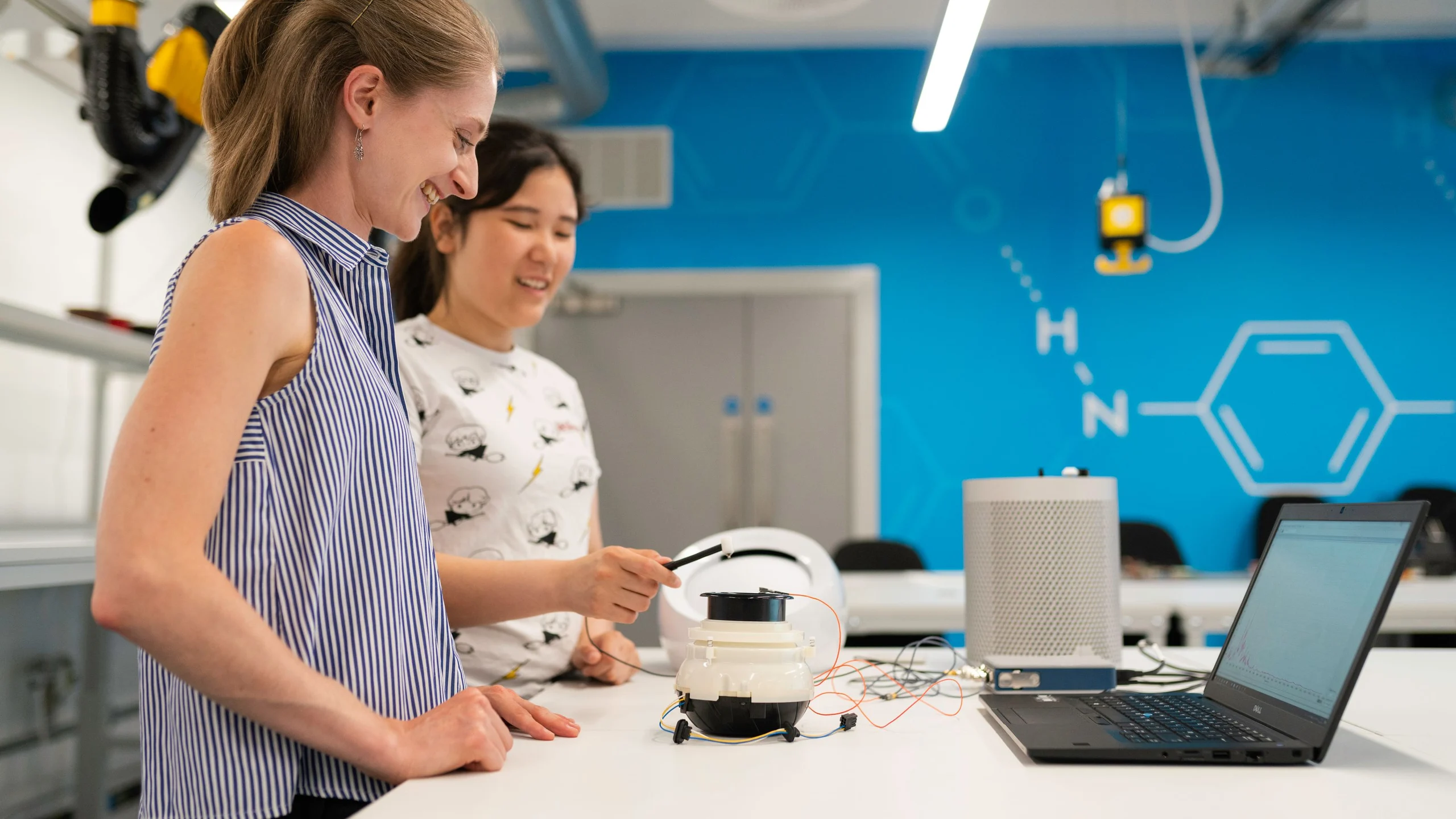
Two engineers examine a wired device on a laboratory bench beside a laptop and other equipment.

Academic and Research Collaboration

Industrial physical AI research benefits from collaboration between people who understand methods, physical systems, and the conditions in which evidence is gathered. Aperture Physical AI Research Labs invites discussions about joint research questions, evaluation methods, and exchanges that connect those perspectives. A useful proposal identifies what is unresolved and how the participants could investigate it together.

Potential work can involve a university group, an independent research team, or researchers within an industrial organization. The starting point is a defined question and complementary contributions. Institutional participation, access, and other commitments need confirmation by the relevant people before they are represented as part of a collaboration.

Propose A Question With A Shared Research Contribution

Explain the limitation in an existing method or body of evidence and why the physical context matters. A study might examine how uncertainty in observations affects a planning method, how a simulation represents a measurable physical behavior, or how an evaluation protocol handles changing operating conditions.

Identify what each group could contribute. One participant may develop the method, another may provide measurement expertise, and another may help define the industrial task. Describe the dependency between those contributions so a proposed collaboration has a research purpose beyond exchanging names or resources.

Explore Forms Of Joint Work

Methods and reproducible experiments

Discuss a specific method, comparison, or experiment that others could examine. Define the inputs, assumptions, configuration, reference evidence, and versioned outputs needed to interpret the result. Reproducibility may be limited by access to equipment or restricted data; document those limits and consider what supporting material could be shared.

Evaluation and research exchanges

A joint evaluation can compare methods under an agreed protocol or examine whether a conclusion holds in another setting. A research exchange can support a defined contribution, such as measurement design or analysis of failure cases. Access to facilities, supervision, timing, location, and resources must be agreed for the actual engagement.

Keep simulation and physical evidence distinct

A shared experiment should identify which results come from a model and which come from physical observations. Agreement between selected simulated and measured cases can support a bounded conclusion. It does not establish that the representation covers every operating condition or that an action is ready for operational use.

Design The Comparison Before Interpreting Results

Agree the question, baseline, candidate methods, case selection, and outcome measures. Where participants adapt methods using shared examples, separate that development material from the evidence used for the final comparison. Retain unresolved cases and conditions in which a method cannot produce a useful result.

Define the unit of evidence. Repeated measurements from the same machine, item, or event may be related. The evaluation design should reflect the intended claim, whether that concerns a new event, another machine, or a different site. Record changes to the protocol so later readers can understand how the study developed.

Plan Access and Review Arrangements

Identify who can authorize the use of equipment, software, observations, and existing research material. Discuss data handling, participant responsibilities, background resources, and expected outputs before work begins. A contribution should be usable for its agreed purpose without assuming permission for broader reuse.

Clarify supervision and the limits of researcher access in a physical setting. A visiting researcher or shared analysis role does not carry authority to alter operational equipment. The project needs a local contact and a defined process for questions, unexpected conditions, and proposed changes.

Agree How Outputs Will Be Credited and Shared

Discuss authorship, contributor acknowledgment, publication review, intellectual property, and dissemination as part of the collaboration agreement. Identify the review needed for confidential material and the outputs that participants intend to make available. Do not assume that sharing observations establishes permission to publish them.

A useful research record can include a method description, experiment configuration, analysis, and limitations even when a hypothesis is not supported. Claims about institutions, collaborators, publications, or completed experiments should follow approved records rather than anticipated participation.

Begin With A Research Outline


Send a nonconfidential summary of the question, relevant prior work, proposed contributions, available resources, and expected form of output. Identify your research group and the contact who can discuss participation. Public papers, repositories, or a short method description can help establish the technical context.

The initial discussion can clarify fit with the research programs and the evidence needed for a more specific proposal. Funding, exchange arrangements, access, timelines, and commitments remain matters for the participants to agree for the defined work.

Scroll to Top