
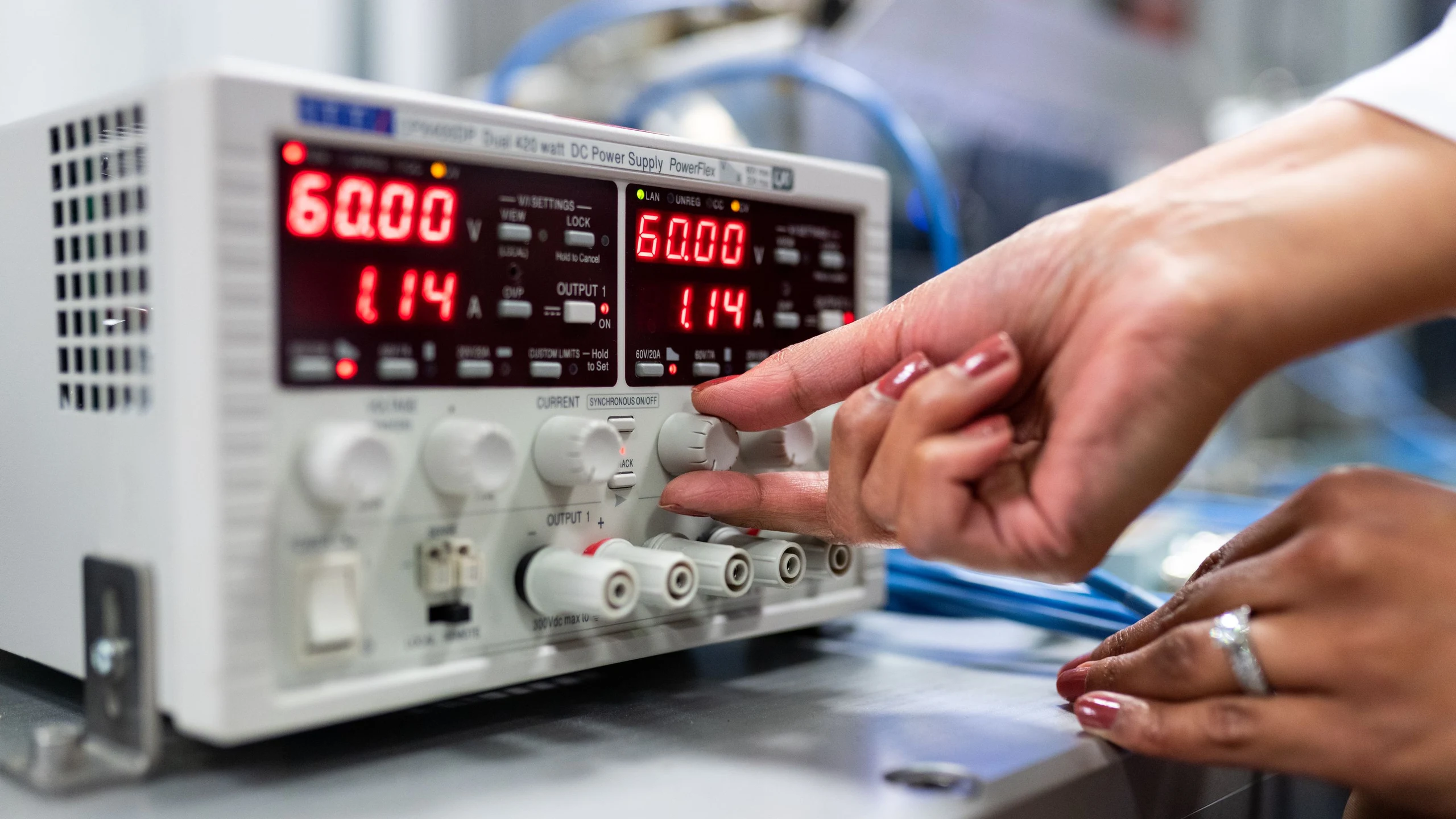
An engineer adjusts a bench power supply with illuminated readouts and connected cables in a laboratory.

Identification and Sensing

An industrial decision depends on knowing what an observation describes and whether it is suitable for the task. A sensor can report a plausible value while its equipment association is wrong, its timestamp is old, or its operating context is missing. Identification and sensing connect the record to the physical situation it is meant to represent.

This category explains how different observations can be combined, how uncertainty and age affect their meaning, and how measurement records become useful evidence. The guides address technical leaders, engineers, researchers, and partners evaluating industrial AI methods. They begin with the physical question and retain the limits of what the observations can establish.

Explore The Three Guides

Multimodal Observations

Learn how observations from different sensing methods can contribute to one task. A packaging example combines an identifier read, camera evidence, and weight information. The guide examines association, alignment, disagreement, and missing inputs, and explains why additional sensors improve a decision only when their contribution is evaluated.

Read Multimodal Observations

Uncertainty and Stale State

Understand the difference between a measurement, an estimate, a confidence score, and information that no longer describes the current state. A moving-cart example examines capture time, communication delay, clock disagreement, and predictions between observations. The guide explains how to preserve unknown conditions rather than silently replace them with definite values.

Read Uncertainty and Stale State

From Sensor Data to Useful Decisions

Follow a measurement record through equipment association, quality checks, context, analysis, and a defined user workflow. A compressed-air example examines whether observations can support an investigation priority. The guide separates technical accuracy, operator usefulness, and economic value and shows where independent outcome evidence is needed.

Read From Sensor Data to Useful Decisions

Begin With Identity and Physical Meaning

Specify the asset, sensor location, observed quantity, units, and capture time. Record how those relationships are maintained when equipment is replaced, instruments are moved, or identifiers change. An association that was correct during collection may need a different valid time range after a maintenance event.

Measurements and estimates should also identify their quality and intended use. A direct instrument reading, a model-derived state, and an inferred identity are different forms of evidence. Keeping their provenance visible helps the next component interpret the information and helps an evaluator investigate an unsuccessful decision.

Preserve Quality Across The Interfaces

Uncertainty and freshness

A value needs enough information to describe its limits and age. A recently received message may contain an old observation. A model can be confident within familiar conditions while the physical setting has changed. The receiving workflow needs defined handling for those conditions rather than treating every populated field as dependable state.

Unknown is a meaningful condition

A missing observation, ambiguous identity, invalid measurement, and stale value require different explanations. Preserve these distinctions through filtering, aggregation, and model output. They may justify another observation, a narrower claim, or a deferred decision, depending on the evaluated task.

Connect Sensing To The Research Question

Choose a relevant baseline and an independent reference before comparing methods. Test ordinary operation and defined degraded cases, including missing inputs or delayed observations where appropriate. Describe the machines, conditions, and operating regimes examined, then report uncertainty, failed cases, and remaining limits.

The hub’s Identification and Sensing program owns measurement validity and physical state-estimation research. Equipment Health and Quality owns diagnostics and quality inference; AI Decisions and Control owns planning and process intervention. Security research addresses adversarial interference. These responsibilities connect through shared evidence without becoming the same question.

Choose The Guide For Your Problem

Start with Multimodal Observations when your task combines sensing methods. Choose Uncertainty and Stale State when timing or incomplete evidence is central. Read From Sensor Data to Useful Decisions when you need to connect analysis to a user task and an outcome that can be evaluated.

Scroll to Top