
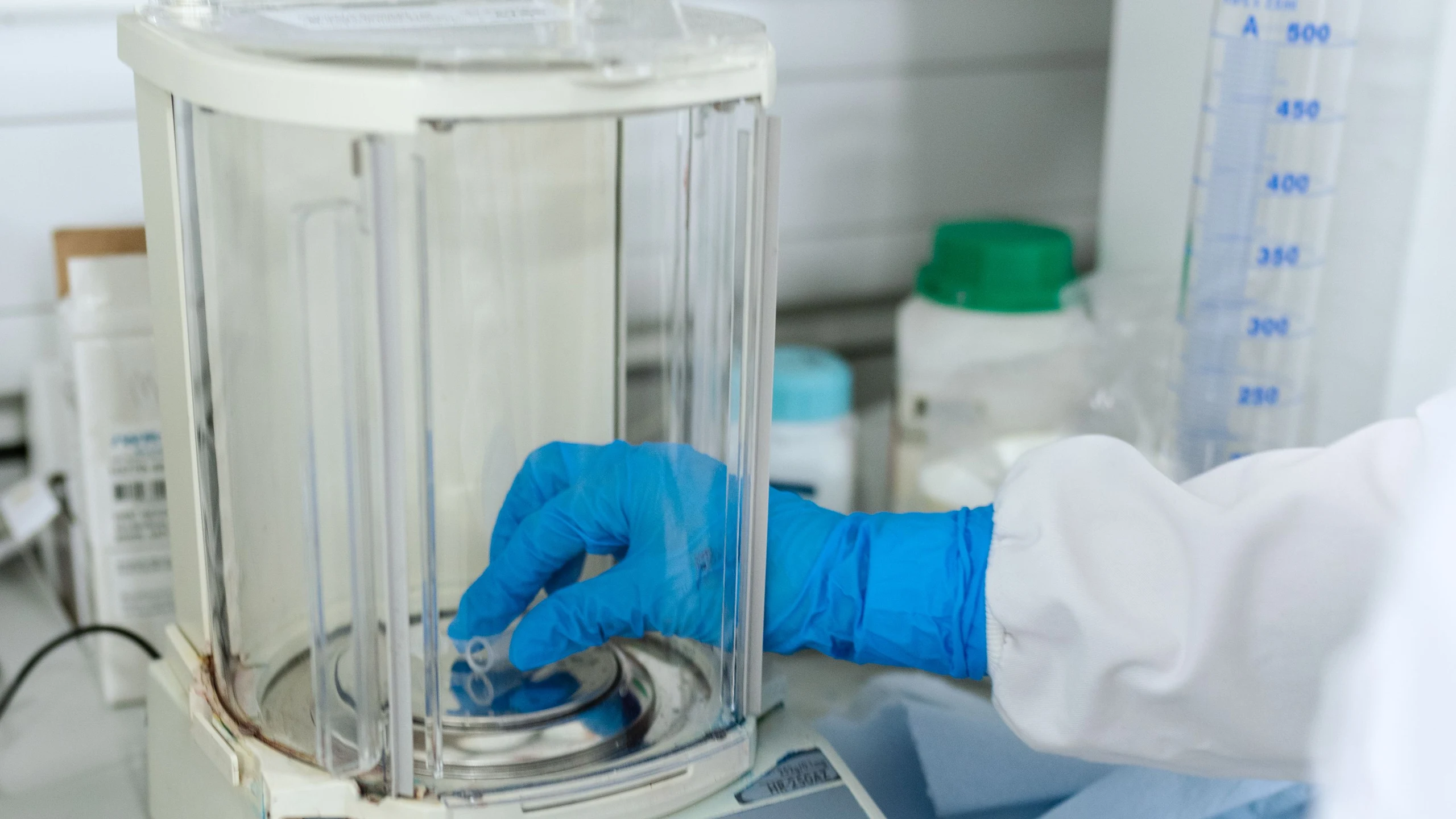
A gloved laboratory worker handles a small sample inside an enclosed electronic balance on a workbench.

Uncertainty and Stale State

An industrial system rarely has a complete and perfectly current description of the physical world. Measurements have limits, identities can be ambiguous, and observations arrive after the situation has changed. Uncertainty describes limits on what is known; stale state describes information whose age or validity makes it unsuitable as a current description for a particular task.

These conditions are related but different. A fresh observation can be inaccurate or ambiguous. An older observation can accurately describe the past while being unsuitable for an immediate decision. A useful interface preserves both the meaning and the age of its evidence instead of reducing them to one unexplained confidence score.

A Moving Cart Example

Imagine a proposed study that estimates the position of a cart moving between work areas. A position observation is captured at one time, processed later, and received after a communication delay. By the time a receiving application displays it, the cart may have moved.

The study could ask whether explicitly representing observation age and position uncertainty reduces incorrect location assignments compared with a method that always uses the most recently received value. This is an illustrative evaluation question, not a completed Aperture tracking study or an approved movement-control procedure.

Distinguish The Kinds Of Uncertainty

Measurement uncertainty

Measurement uncertainty characterizes the dispersion of values that can reasonably be attributed to the quantity being measured. Instrument resolution, calibration information, environmental influences, and the measurement procedure can contribute. The relevant quantity and conditions need to be defined before a numerical uncertainty statement can be interpreted.

Uncertainty is not the same as a known error or a mistake. Repeating an observation can help assess variation, but it does not automatically remove a common bias or an incorrect equipment association. Calibration information is useful within its stated conditions and does not make every later use equally well characterized.

State and model uncertainty

A state estimate combines observations and assumptions about the physical process. It may be uncertain because observations are sparse, motion is variable, identity is ambiguous, or the model does not cover the current operating regime. Keep those limitations distinct from the uncertainty of an individual instrument reading.

Confidence scores

A model confidence score needs a defined meaning and an evaluation of how it relates to correctness. A high score may concern a classification among known options rather than the accuracy of a position or the freshness of a measurement. Scores from different models should not be treated as equivalent without evidence.

Record The Relevant Times

Distinguish capture processing and arrival

Capture time identifies when an observation was made. Processing time identifies when a computation used it. Arrival time identifies when a receiving component obtained the result. The application also needs to know the time to which a state estimate applies, which can differ from all three.

In the cart example, a message received now could contain a position captured earlier. Retain that capture time and any timing uncertainty. A retry or retransmission should not make an old observation appear newly captured. A device heartbeat shows communication activity, not necessarily a new physical measurement.

Account for clock differences

Comparing times from different devices requires an understood clock relationship. Clock offset, drift, timestamp resolution, and synchronization behavior can affect the apparent age or ordering of events. Where the relationship is uncertain, describe that limit rather than infer exact sequence from incompatible timestamps.

Define Freshness Around The Task

A location record may remain useful for historical traceability after it is unsuitable for coordinating a current task. Freshness therefore depends on the rate of physical change, the decision window, and the consequence of relying on an old state. A single expiration interval is not appropriate for every quantity or workflow.

For a proposed cart study, evaluate how different observation delays affect the location decision under stated motion conditions. Do not invent a universal maximum age. Agree any acceptance limits with the responsible technical lead using the task requirements and evidence from the evaluated setting.

Distinguish A Current Estimate From A New Observation

A model can predict where a cart may be between observations. That can be useful, but the result is a prediction with assumptions and uncertainty. Identify its target time, last supporting observation, model version, and applicable motion conditions.

Extrapolation does not create a new physical measurement. If the cart can stop, change direction, or take an unobserved route, the estimate may become less informative. A receiving component should be able to distinguish measured position, predicted position, and an unresolved current location.

Keep Invalid Missing and Stale Records Separate

An invalid observation fails a defined quality check. A missing record was not available. A stale record is too old or no longer valid for the intended use. An ambiguous identity concerns which object the record describes. These conditions need different explanations and can require different responses.

Preserve them through aggregation and model output. Replacing a missing value with zero or carrying forward an old value without its age can make uncertainty disappear from the interface while remaining in the physical situation. An explicitly unresolved state is often more informative than an unsupported definite answer.

Choose and Evaluate The Receiving Response

A proposed evaluation can vary observation delay, missing intervals, clock offsets, and motion conditions while retaining an independent location reference. Compare incorrect assignments, unresolved cases, response time, and review burden against the baseline. Keep simulated scenarios separate from physical measurements and retain failed cases.

Report What The Evidence Supports


Describe the machines or objects, operating regimes, timing assumptions, reference quality, and sample scope examined. Report whether an improvement concerns uncertainty representation, current-state estimation, or the downstream decision. Those are related results with different meanings.

A method that handles one range of delays may still need evaluation after a sensor, network, or workflow change. Use the observed failure boundary to choose the next investigation rather than present one successful configuration as a generally current view of the physical world.

Scroll to Top