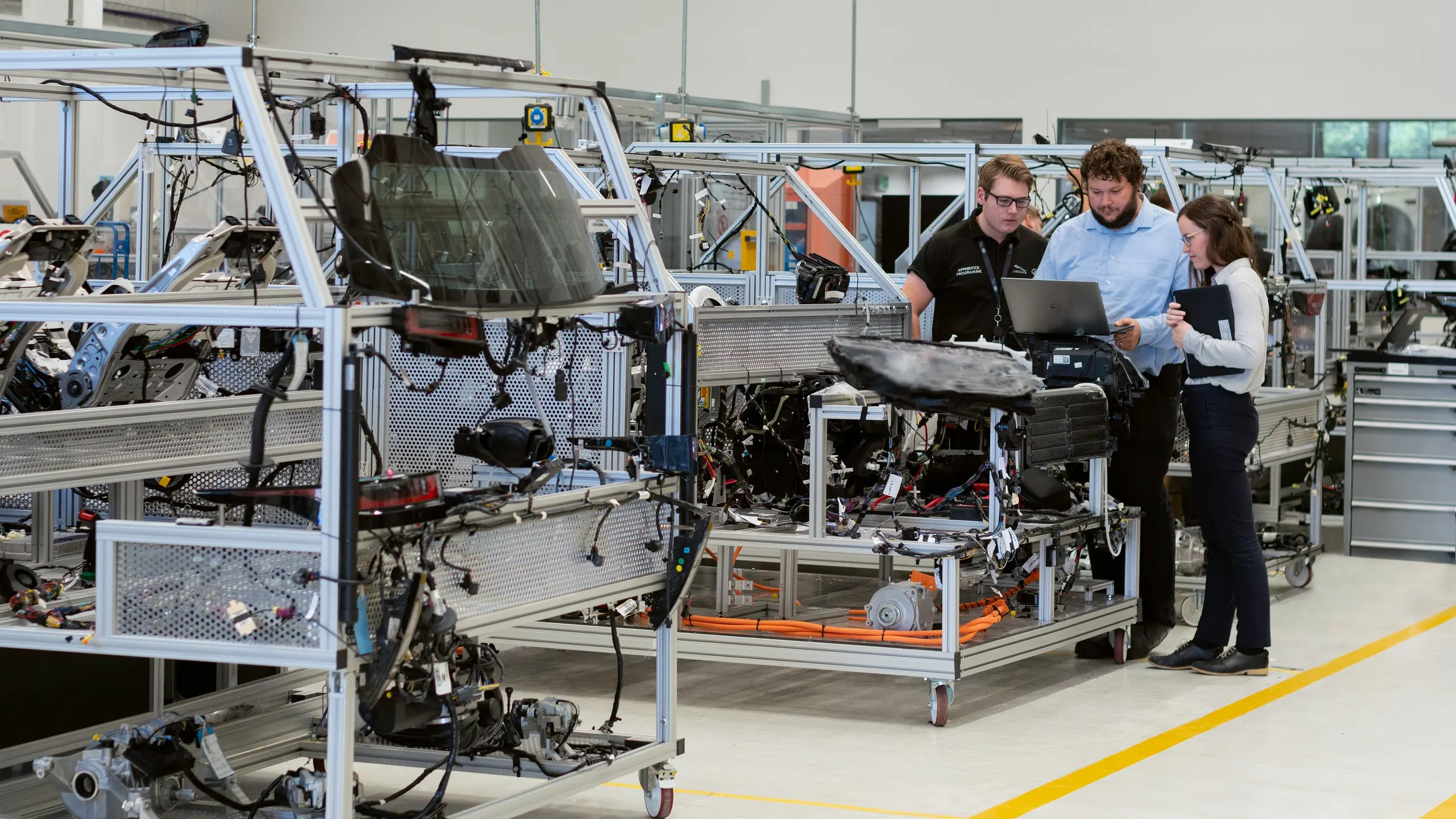
Three engineers review a laptop beside exposed vehicle assemblies in an industrial engineering workshop.

Projects and Demonstrations

Industrial AI research needs a clear account of the physical problem, the method being examined, and the evidence gathered. A project defines the question and its scope. A demonstration shows a particular configuration or behavior. Research outputs preserve methods, findings, and reusable resources so that readers can examine the work in more detail.

This section connects those records across the Aperture research programs. Use it to understand what a study is trying to establish, which stage it has reached, and what remains uncertain. A demonstration can help explain a method, but the accompanying evaluation determines which conclusions its evidence supports.

Find A Research Project

Project records describe the industrial question, participating programs, and intended comparison. Each record identifies a dated stage, the relevant equipment or digital environment, and the evidence available at that stage. Proposed work is identified as proposed; methods and anticipated benefits are kept separate from observed findings.

A cross-program project may combine sensing, decision methods, simulation, and human oversight. Its record explains how those contributions connect without implying that every participating program has completed the same evaluation. Detailed specialist experiments remain with their owning program, with a summary and link here where useful.

Project records

No project records are available in this section yet. Explore our research programs or discuss a research question with us.

Watch A Demonstration In Context

Demonstration records explain what a video or interactive example shows. The record identifies whether the material comes from simulation, recorded physical testing, a live demonstration, or a supervised pilot. It also describes the setup, configuration, date, and boundaries of the example.

A visible response is not a substitute for a baseline or an independent outcome measurement. Read the transcript and limitations alongside the recording, especially when a demonstration omits preparation, recovery, repeated trials, or unsuccessful cases. Editing and playback changes should be disclosed when they affect interpretation.

Read The Supporting Research Outputs

Outputs can include technical reports, publications, datasets, benchmarks, and associated resources. Their records provide authorship, date, version, access conditions, and the relationship to the project or demonstration. Readers should be able to distinguish an internal technical report, a preprint, and a peer-reviewed publication.

An output may describe useful methods even when a study is inconclusive. Its findings should retain the tested boundary, reference evidence, failures, and limitations. Dataset availability and benchmark scores should be interpreted using the collection conditions, permitted uses, and evaluation protocol supplied with the resource.

Understand The Research Stage

Proposed and in progress

A proposed study defines the question and planned evaluation. Work in progress describes activity supported by current records without presenting expected outcomes as findings. Either stage may identify unresolved access, instrumentation, or reference-data needs.

Testbed pilot and defined deployment

A testbed demonstration concerns a specified setup. A supervised pilot concerns a bounded operational trial with stated responsibilities. Deployment concerns a defined use and configuration. Evidence from one stage does not automatically establish performance in a broader environment.

Read the evidence boundary

Check which machines, sites, operating conditions, users, and versions were examined. Separate simulated outcomes from physical measurements. Where findings do not resolve the original question, the record should explain the remaining uncertainty and the next investigation.

Explore The Methods Behind The Records

The research approach explains how questions move through digital experiments, physical tests, and supervised pilots. Experimental evaluation describes baseline selection, ground truth, independent cases, and uncertainty. These methods help readers assess a record rather than infer readiness from a title or video alone.

Bring Us A Physical Research Question

Describe the equipment or process, current workflow, available observations, constraints, and outcome you want to evaluate. Begin with a nonconfidential summary so the relevant programs and study boundary can be identified.

Scroll to Top