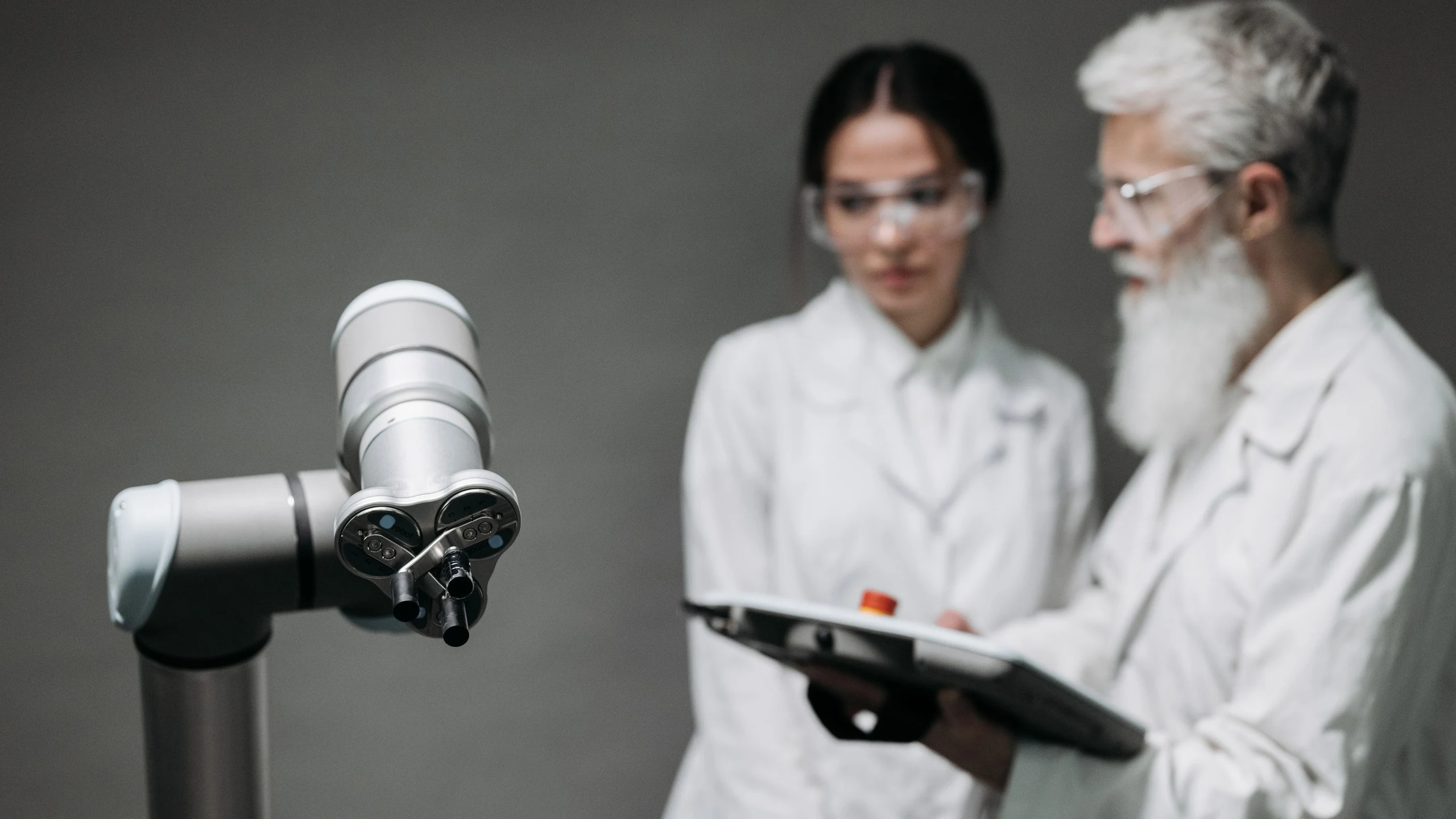
Two researchers wearing safety glasses review a tablet beside a robotic arm and gripper in a laboratory.

What Is Industrial Physical AI

Industrial Physical AI connects AI-supported understanding and decisions to tasks involving equipment, materials, and physical processes. Its scope includes the observations used to describe a situation, the constraints governing a response, and the evidence showing what happened afterward. The practical question is whether the complete system can support a defined physical task under stated conditions.

At Aperture, the architecture is described through Identification, Sensing, AI Decision, and Physical AI Action. These are functional roles rather than a claim that one model performs every task. Existing sensors, controllers, software, people, and robotic platforms can contribute to the system. The research concerns their behavior and interfaces as well as the AI method.

Begin With A Physical Task

Consider a proposed conveyor study in which mixed containers need to reach the correct destination. The task is more specific than recognizing a container in an image. A useful response also depends on its identity, position, conveyor movement, destination rules, available equipment, and the time left before a routing decision must take effect.

The research question might ask whether an AI-assisted routing method reduces misroutes compared with the current procedure under matched conditions. That requires a baseline, an independent record of destinations, and a defined set of containers and operating states. This is an illustrative study design, not a report of an Aperture installation or result.

What Makes The Problem Physical

Observations are incomplete

A camera may miss a label, an identifier may be ambiguous, or a position estimate may arrive after the container has moved. Sensor readings describe observations at particular times and locations. The system must preserve uncertainty and recognize when the information no longer supports the intended decision.

Actions change later observations

A routing command can change where a container goes, which changes what downstream sensors observe. Evaluating a policy on a fixed recording cannot always capture that interaction. A digital model can explore alternative responses, subject to its assumptions; physical testing is needed to examine the actual equipment response.

Timing and equipment limits matter

An otherwise suitable instruction may arrive too late for a diverter to move. Travel speed, actuator response, object spacing, and communication delays shape the feasible decision window. Research needs to evaluate those dependencies rather than infer task performance solely from image-classification accuracy.

Separate The Functional Roles

Identification associates a record with the correct object or equipment. Sensing describes its condition and relevant state. AI Decision interprets that context and selects or recommends a response. Physical AI Action connects an authorized choice to an operational response and, where included, equipment execution.

These roles may run on different devices and use different methods. A conventional controller can still perform the equipment-level movement while an AI method proposes a task or setting. Physical AI does not require replacing the existing controls or using a robot in every application.

Distinguish The Model From The Complete System

A model may estimate container type from an image or predict the likely effect of a route. The system must additionally manage asset references, time, communications, permissions, command handling, and outcome records. A model score cannot answer all of those questions.

This distinction helps assign failures correctly. A misroute could result from a classification error, an outdated position, an incorrect destination mapping, a rejected command, or an actuator response. The investigation should connect the timeline and independent observations rather than attribute every unsuccessful task to the model.

Human Approval Can Remain Part Of The Task

Some applications present recommendations that a person reviews before any equipment change. Others permit a narrow set of automatic actions under agreed conditions. The degree of autonomy depends on the task, consequences, operating policy, authority, and evaluated behavior. More autonomy is not a research result by itself.

Define intervention before a trial

Specify who can approve or pause the study, what information they receive, and how an existing procedure is restored. If information is missing or the task leaves the evaluated boundary, the system needs a defined response. A person named as supervisor must have a practical way to understand and intervene.

Measure the response to an exception

A visible warning is only one event in an intervention path. Evaluate whether it was noticed, understood, acted on, and followed by the required physical response. Keep unsuccessful interventions and unnecessary interruptions in the evidence alongside successful cases.

Evaluate The Physical Outcome

In the conveyor illustration, a command acknowledgment would establish what an interface reported. It would not establish that the intended container reached the correct destination. A separate destination observation, appropriately associated with the object, would help assess the outcome.

Candidate measures could include misroutes, unresolved identities, response delay, throughput under comparable demand, and intervention frequency. Define the measurement units and sample scope before testing. Report repeated trials, uncertainty, excluded cases, and failures rather than presenting one selected successful sequence as representative.

Use Digital and Physical Evidence For Different Questions

Recorded-data replay can examine recognition and data handling on shared observations. Simulation can investigate interactive decisions and defined disturbances. A testbed can examine actual sensing, communication, and equipment behavior. A supervised pilot can investigate a bounded operational workflow with assigned responsibilities.

Each stage leaves its own limits. A model may transfer poorly between lighting conditions, containers, or conveyor configurations. An evaluation should state which variations were examined and what remains unknown. A demonstration in one setting does not establish readiness for every machine or site.

Where To Go Next

Read Physical AI and AIoT to understand Aperture terminology, or Why Physical Context Matters to examine the information behind a decision. Use the research approach pages when turning an application idea into a testable question.

Scroll to Top