
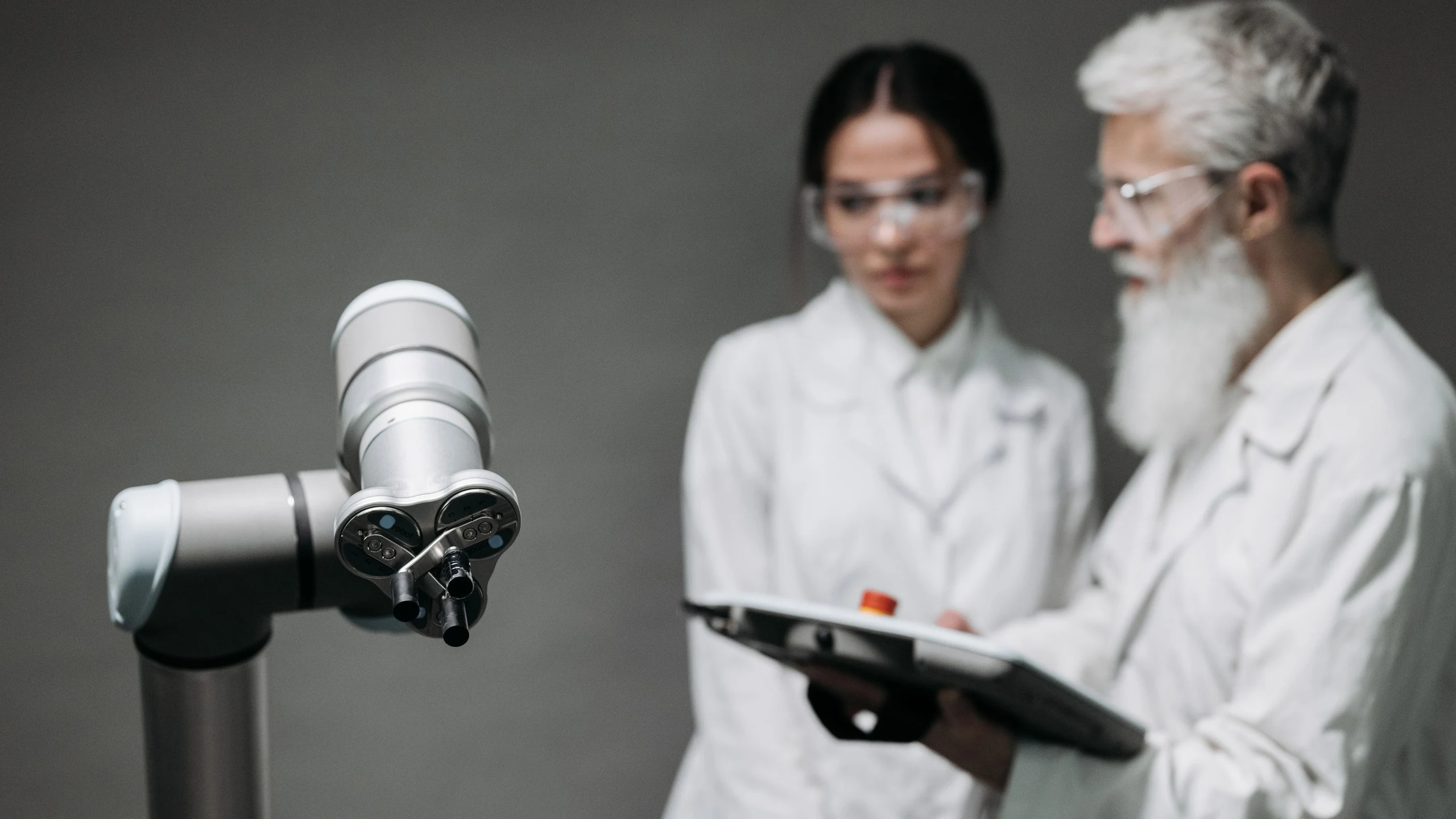
Two laboratory researchers review a handheld interface behind a robotic arm with an open gripper.

Perception Planning and Action

Perception estimates relevant properties of the physical setting. Planning selects a proposed way to achieve a task within constraints. Action carries a request into the equipment’s assigned execution behavior. The task also needs observation of the result, because a valid looking estimate and a completed command do not necessarily produce the intended physical outcome.

These functions connect through assumptions about identity, time, geometry, authority, and equipment capability. Research should examine those interfaces as well as the individual methods. A strong perception score and a fast planner can still form an unsuccessful system when their outputs describe different moments or incompatible physical conditions.

A Bin Picking Example

Consider a proposed study in which a robot selects one specified component from a bin and places it at a receiving location. A camera produces observations, a method estimates the component’s identity and pose, and a planner proposes a grasp and movement. The executing equipment then follows its defined motion interface.

The research question could ask whether preserving pose uncertainty through candidate selection improves successful transfers compared with selecting the highest scoring object estimate alone. This example is a conceptual study design, not a description of an Aperture cell, validated grasping system, or operating instruction.

Define The Task Before Estimating The Scene

Specify which component is required, which receiving state counts as completion, and what variations are included. Picking any visible object is a different task from retrieving a particular part in an acceptable condition. State the object range, bin arrangement, sensing setup, tooling, and operating conditions examined.

Choose an independent completion observation. The gripper closing may not establish that it holds the intended part. Arrival at a placement pose may not establish that the part was released into the expected location. Keep those differences in the task record so the evaluation measures the actual physical objective.

Perception Should Retain Its Limits

Identity and pose

An estimate needs to describe which object it concerns and where that object is relative to a defined frame. Similar components, occlusion, lighting, and reflective surfaces can complicate interpretation. A high classification score does not automatically characterize pose accuracy or establish that the object is accessible to the gripper.

Observation time and geometry

Retain capture time and the transformations relating the sensor, robot, tool, and workspace. A changed camera mounting or moved object can invalidate an earlier geometric relationship. Calibration and timing assumptions need to be evaluated in the actual setup rather than inferred from a visually convincing overlay.

Unknown space is not confirmed free space

An unobserved region behind an object does not provide affirmative evidence that a proposed motion is clear. Explain how incomplete observations affect candidate selection and the next sensing step. The appropriate handling follows the equipment and study design; a generic perception label cannot establish the required protective behavior.

Planning Connects Estimates To Feasible Candidates

A grasp candidate needs to fit the object estimate, tool geometry, available reach, and task constraints. The planner may compare several candidates or request another observation when the evidence is inadequate. Retain why a candidate was selected and which assumptions made it admissible.

The most confident object estimate may correspond to a poor grasp opportunity. Conversely, a plausible grasp pose may concern the wrong part. Evaluate the decision that connects those two kinds of evidence instead of assuming that optimizing each component separately will optimize the whole task.

Execution Needs A Defined Contract

The accepting interface should identify the task, equipment, proposed parameters, and current conditions required for its scope. It should distinguish a request from an accepted operation and expose a useful execution state. The robot’s configured control and protective responsibilities remain part of the equipment arrangement.

During execution, the object or workspace may change. The relevant response must be defined by the responsible design, including any conditions for further observation or intervention. A planner’s ability to generate a new trajectory does not establish that replacing an active one is appropriate under the current physical state.

Observe The Physical Result

After the attempted grasp and placement, associate outcome evidence with the correct task. Possible observations might concern the item held, the receiving location, or the presence of the intended part after release. Their suitability and uncertainty need to be established independently of the planner’s internal success flag.

Preserve partial completion. The robot may have moved an object without completing the requested transfer, or the final identity may remain unresolved. A timeout is similarly ambiguous if execution or communication may still be pending. Reconcile that state before initiating another operation that could duplicate or conflict with the first.

Recover Within The Same Task Boundaries

A failed attempt can lead to another observation, an alternative admissible candidate, or a request for human help. The recovery policy should have defined scope and a way to end without completion. Repeating the same attempt indefinitely can alter the physical scene and make the original assumptions less applicable.

Record each attempt, its supporting estimate, and its result. A successful final transfer after several interventions should not be reported as an uninterrupted autonomous success. Retaining the sequence helps researchers determine whether the limiting issue concerns perception, planning, tooling, execution, or the receiving workflow.

Evaluate Components and The Complete Sequence


Component tests can examine identity accuracy, pose error, candidate feasibility, and interface behavior. Integrated tests need task completion, wrong item transfers, incomplete placement, elapsed time, repeated attempts, and human recovery effort. Report sample scope, uncertainty, and failed cases alongside the aggregate result.

Use matched objects and conditions when comparing methods, and keep development cases separate from evaluation cases. Simulation can test logic and explore variations, while physical observations reveal contact behavior and sensing effects that the model may omit. The result should state which interface assumptions held, where the sequence failed, and what additional evidence a broader task would require.

Scroll to Top