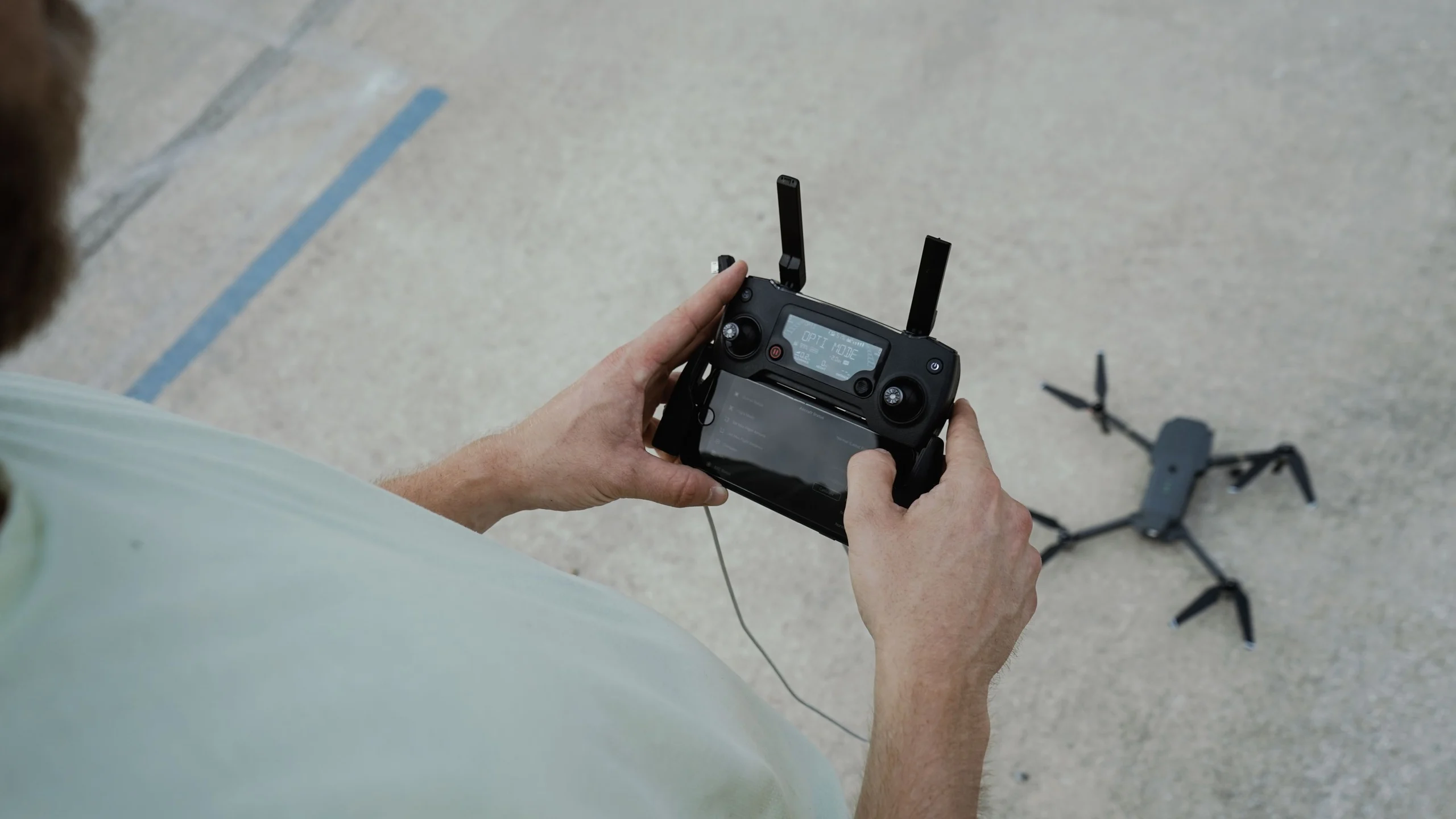
A drone operator holds a controller while a small quadcopter rests on a paved outdoor surface nearby.

Robots Drones and Autonomous Vehicles

Robotic arms, aerial drones, and autonomous ground vehicles connect computation to different physical capabilities. A manipulator can reach and handle objects within a workspace. An aerial platform can observe locations from above. A ground vehicle can move a payload between areas. Choosing a platform starts with the work and the physical access it requires.

These categories overlap. A mobile robot can carry a manipulator, and a drone can be remotely operated or execute a bounded automated mission. The platform name does not establish its autonomy, suitability, or performance. A research study should describe the task, environment, human involvement, and independently observed result.

An Industrial Inspection Example

Consider a proposed study to collect repeatable images of equipment condition. Some inspection points are beside an aisle, others are elevated, and some require a sensor to approach a component closely. A team could investigate which platform can obtain the required evidence with acceptable preparation and operator effort under a defined setup.

The result should concern usable inspection evidence, not movement alone. Reaching a waypoint does not prove that the correct component was visible or that image quality supported the inspection question. This example is a proposed comparison, not an Aperture facility description or an approved operating plan for any platform.

Match The Platform To The Physical Task

Fixed and mobile manipulators

A robotic arm can position a tool or handle an object within its physical reach. Tooling, payload, accessibility, positioning, and contact requirements shape the task. A fixed setup may simplify location and repeatability, while a mobile base introduces additional state and positioning questions before manipulation begins.

For the inspection example, an arm could support repeatable sensor positioning at a prepared station. The study would need to examine whether the required component is accessible and whether the sensing arrangement provides useful evidence. A motion that reaches the intended pose is only one part of that question.

Aerial drones

An aerial platform can access elevated viewpoints without following the same ground route as a vehicle. Its observation can still be limited by viewpoint, obstruction, lighting, motion, or the sensor payload. Energy, communication, and the surrounding physical conditions affect what mission can be investigated.

Separate the capability to collect an image from permission to conduct a flight. The responsible team must establish applicable operating requirements and site arrangements for any physical study. This educational comparison does not set those requirements or imply that a platform suitable for one environment is approved for another.

Autonomous ground vehicles

A ground platform can carry sensors or material along routes within a defined area. The usable route depends on the vehicle’s dimensions, load, surface interaction, localization, and available access. A map showing a connection between locations does not establish that the vehicle can physically traverse it under every studied condition.

In the example, a vehicle could gather images along an aisle, but it may need a mast or another positioning mechanism to see the inspection point. Evaluate the full arrangement and preparation effort rather than comparing an aerial viewpoint with a ground image that cannot answer the same question.

Combined platforms need combined evaluation

A mobile manipulator adds reach to mobility while also adding dependencies between base position, arm motion, payload, and sensing. Success of the base and the arm in separate tests does not establish their integrated task performance. Retain the interfaces and calibration assumptions that connect those components.

Describe Human Involvement Precisely

Remote operation, task approval, automated execution, and exception handling represent different allocations of work. State who selects the target, who controls movement, and who resolves uncertainty. The same equipment can operate under different arrangements for different tasks or stages of an experiment.

A platform may complete familiar steps while depending heavily on a person to prepare the workspace, label targets, or recover failed tasks. Include that work in the evaluation. Reducing direct control during movement does not necessarily reduce total operator effort or make the overall inspection process autonomous.

Define Usable Completion Evidence

For inspection, specify the component identity, required view, time, and image quality needed for the intended review. Preserve unsuccessful acquisitions, occluded targets, and ambiguous associations. If the task includes handling an object, establish completion through an appropriate observation of the resulting object state.

Keep the data collection claim separate from diagnostic inference. A clear image may support later review without proving a fault. A thermal or acoustic reading likewise needs its own interpretation and measurement context. The study should not attribute a maintenance conclusion to the platform merely because it carried the sensor.

Compare Methods Under Matched Conditions

Use the current inspection procedure or another relevant baseline. Match the inspected points and evidence requirements, and record preparation, task time, energy use where relevant, incomplete work, and human recovery. Differences in access may mean that some points cannot be compared directly; report that boundary instead of hiding them in an average.

Include changes in viewpoint, target appearance, route availability, and communication within the authorized study scope. Simulated access can help design cases, while physical observations establish what happened in the actual configuration. Separate those findings and retain the equipment and software versions used.

Choose The Next Investigation From The Evidence


A useful result might show that a simpler fixed sensor answers the question more consistently than a mobile platform. It might also identify inspection points where mobility provides access that the baseline lacks. Neither result requires a broad claim that one type of robot is best for industrial inspection.

Report the task coverage, evidence quality, unresolved conditions, and integration effort. Use those findings to decide whether the next step concerns sensing, route design, manipulation, or operator workflow. Expand scope only after the new conditions and responsibilities have been examined.

Scroll to Top