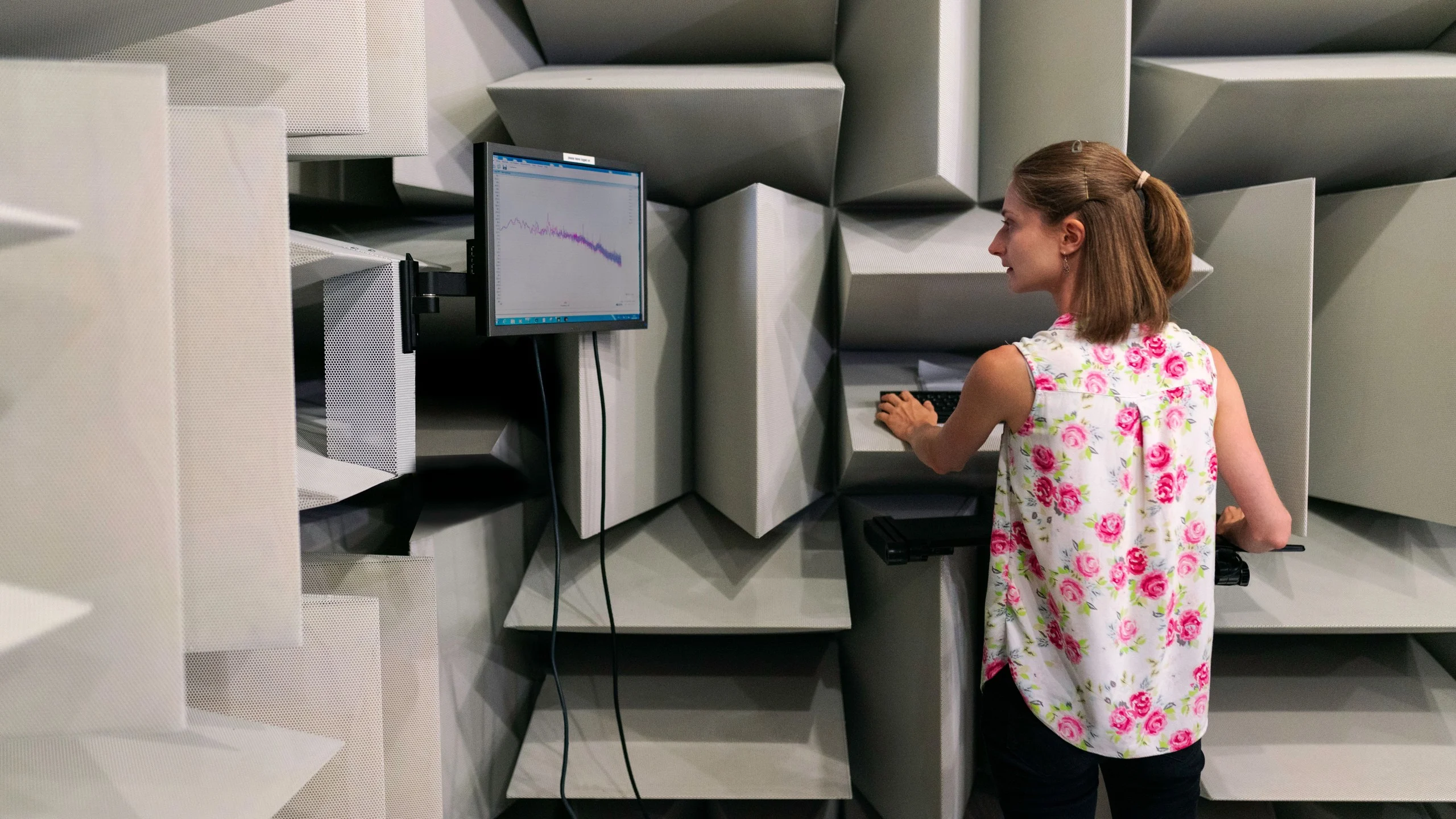
An engineer positions a device beneath a microphone in an acoustic room lined with sound absorbing wedges.

Privacy in Industrial Sensing

Industrial sensors can reveal information about people even when their stated purpose concerns equipment or workflow. A camera may capture faces and movement, an acoustic sensor may capture speech, and a location record may become associated with an individual. Privacy needs to be considered through the information actually collected, inferred, retained, and shared.

This guide provides research design questions for technical leaders, engineers, and partners. It examines how to answer a defined industrial question while limiting unnecessary information about people. It is not a legal determination or a statement of Aperture’s current data practices; applicable requirements and project arrangements need review for the actual setting.

A Workspace Occupancy Example

Consider a proposed study estimating whether a work area is occupied so a team can understand equipment utilization. A camera could supply rich observations, but the research question may require only an area count over selected intervals. Individual identity, conversation, and movement across unrelated areas may add information the study does not need.

The team could compare approaches that retain images with approaches that produce limited local summaries, using a defined independent reference. This is an illustrative research design, not an Aperture monitoring installation or a recommendation to collect workforce data without an agreed purpose and appropriate review.

Define The Purpose and Affected People

Write the specific question, intended output, users, and boundaries of use. In the example, aggregate occupancy for a utilization study differs from identifying individuals or assessing personal performance. A later request to repurpose the same records should be treated as a new use decision rather than an automatic extension of the original study.

Identify who may be observed, including employees, contractors, visitors, and people in adjoining areas. Map when and where collection occurs. A sensor aimed at equipment can still include a corridor or shared workspace, so the stated installation purpose is insufficient to describe its actual information footprint.

Examine What The Sensor Can Capture

Raw observations

Review field of view, resolution, sampling, recording duration, and sensing capabilities. Images, audio, and location records can contain different kinds of information about people. A sensor’s available capability does not mean every function needs to be enabled for the research task.

Derived information

A summary or model output can still concern an individual when combined with timing, location, or another dataset. Removing a name does not necessarily make a movement pattern anonymous. Examine plausible combinations and recipients rather than relying only on whether the original record contains an obvious identifier.

Local processing changes the exposure path

Processing near the sensor can reduce the amount of raw information transmitted or retained. It does not automatically eliminate privacy concerns: temporary buffers, diagnostic logs, remote access, or detailed summaries can still expose information. Trace the actual data path through the selected configuration.

Compare Less Intrusive Ways To Answer The Question

The occupancy study could examine narrower views, lower detail, shorter collection periods, or a sensing approach that avoids recording recognizable images. Each option needs evaluation against the required task. Reducing collection is useful when the resulting evidence still supports the intended conclusion with understood uncertainty.

Do not remove contextual information blindly if it is needed to evaluate errors. For example, an aggregate count may hide missed observations during a particular condition. A carefully bounded and separately governed reference collection may be needed for a limited evaluation, with its own access, retention, and deletion arrangements.

Define Retention and Access Across The Lifecycle

Specify what persists, for what purpose, where it is stored, and who can access it. Distinguish raw observations, derived features, labels, model artifacts, and review records. A short retention period for the main dataset does not address copies in exports, backups, or support logs unless those paths are included.

Assign responsibility for enforcing the agreed limits and handling exceptions. Access for troubleshooting can differ from access for analysis or publication. Keep records sufficient to understand permitted use without creating unnecessary detailed monitoring of individuals through the oversight mechanism itself.

Communicate The Actual Arrangement

People need an understandable account of the collection, purpose, recipients, retention, and route for questions or concerns as appropriate to the setting. Avoid describing a camera as only an occupancy counter if identifiable images are retained elsewhere. The explanation should match the technical configuration and actual project arrangements.

Determine the applicable permissions and obligations with the responsible organizational and privacy reviewers. The appropriate basis and safeguards depend on the jurisdiction, relationship, and use. This guide does not assume that a generic notice or a single consent checkbox resolves every industrial sensing situation.

Govern Sharing and Secondary Use

Data shared with a research partner or service provider needs a defined purpose, scope, access arrangement, and handling expectations. Evaluate the information in the actual export, including timestamps and metadata. A dataset that seems limited in isolation can become more revealing when linked to another source.

Model training, benchmarking, demonstrations, and publication can create uses beyond the initial operational question. Review them explicitly. A public example should not expose identifiable people or sensitive work patterns merely because the original data was available to the research team.

Evaluate Privacy and Task Performance Together

Compare approaches using the same occupancy question and an appropriate independent reference. Assess count quality, unresolved intervals, delay, and error across the studied conditions. Also document the raw information collected, transmitted, retained, and accessible under each configuration.

Privacy risk is not captured by one universal technical score. Use a documented review of affected people, information flows, intended and foreseeable uses, and remaining exposure. Retain uncertainty and limitations rather than declaring that an approach is privacy preserving solely because it uses aggregation or local computation.

Reassess When The System Changes


A wider camera view, new audio capability, longer retention, a different recipient, or a new inference can change the privacy question. Keep the configuration and use decision linked to the research record. Reassess the affected data path before treating the change as routine maintenance.

The useful result is a justified sensing arrangement for the defined question, with evidence of task performance and an understandable account of information about people. Report the collection and use limits alongside the findings so the study can be assessed without implying broader permission or anonymity than was established.

Scroll to Top