
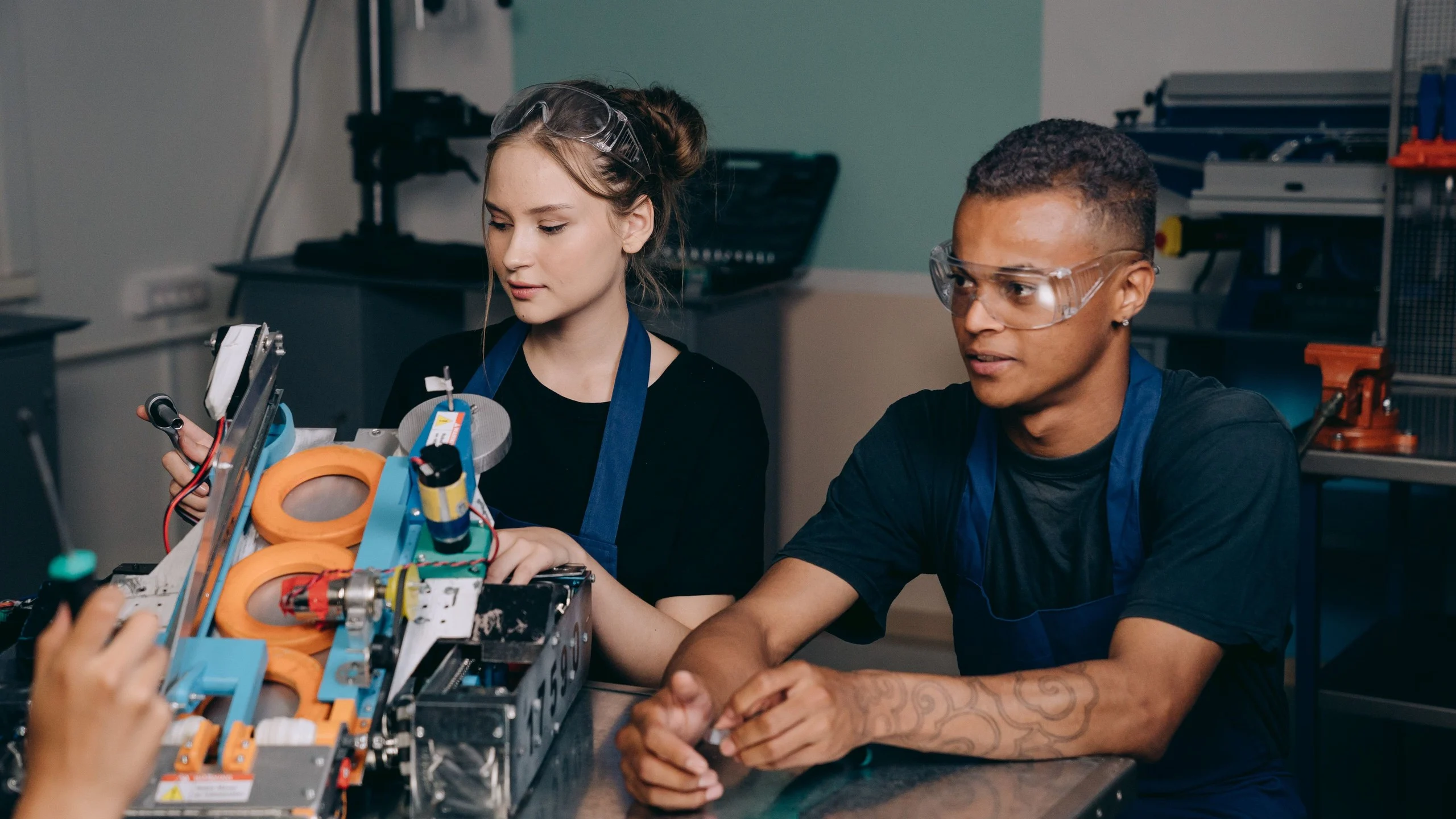
Two people wearing safety glasses examine an electronic prototype at a workshop bench.

About

Aperture Physical AI Research Labs is the central research hub for eight complementary programs in industrial physical AI and AIoT. The hub connects research questions, shared methods, introductory knowledge, and evidence across those programs. Detailed specialist research belongs with the relevant program, while this site helps readers understand how the work fits together.

The research goal is to connect dependable observations with useful decisions, authorized actions, and evidence of what happened in the physical world. That goal covers connected equipment as well as robots, drones, and industrial vehicles. Each project needs its own defined scope and evidence; a broad research agenda does not establish that every capability is complete.

Start With The Physical Question

Industrial observations can be incomplete, delayed, incorrectly associated, or unsuitable for the decision at hand. A model may perform well on recorded cases while leaving its behavior under changed conditions unresolved. A recommended action may be accepted by an interface without producing the intended physical result.

These gaps shape the research questions addressed here. The task is to identify what a method can support, under which conditions, and with what uncertainty. A useful result may be an improved method, a clearer evaluation, a better measurement arrangement, or a justified decision to narrow or stop a study.

Connect Eight Complementary Programs

The program network covers identification and sensing; equipment health and quality; decisions and control; digital twins and simulation; robotics and distributed intelligence; assurance, oversight, and connectivity; security and trusted industrial AI; and knowledge, learning, and deployment.

Each program has a distinct scientific responsibility. Measurement validity belongs with sensing research, while equipment diagnosis concerns the interpretation of those observations. Control and robotic policies require their own evaluation. Security and human oversight extend across the workflow without becoming additional engines or replacing the other programs' responsibilities.

Use Shared Methods and Assessable Records

From a question to a comparison

The research approach connects a physical problem with a hypothesis, baseline, observations, reference evidence, and an evaluation appropriate to the question. Digital experiments can examine assumptions and candidate behavior. Physical tests and supervised pilots can investigate questions that a digital setting cannot resolve alone.

From a result to a limited claim

A research record should explain its configuration, conditions, findings, failures, and remaining uncertainty. Simulated outcomes, measured physical results, and operator judgments need to remain distinguishable. Proposed work and completed evaluation should be identified at their actual stages.

Keep evidence connected to the next decision

The next step may involve another experiment, a revised method, a narrower task, or a controlled release where justified. Research progress is more useful when the record explains that decision than when a demonstration is presented as general proof of readiness.

Understand The Wider Research Relationship

The hub connects to Aperture Venture Studio's published Physical AI and AIoT research initiative. The studio's research and portfolio context helps explain the industrial questions addressed across the network. A research relationship, a commercial offering, and a deployment claim are different statements and need their own supporting records.

Find The Information Relevant To Your Question


Explore the Mission and Scope page for the research boundaries, the Research Network for program ownership, and the Research Team page for how contributions and responsibilities are described. News and Updates provides a route to approved announcements as they become available. To discuss a physical problem, begin with a short nonconfidential research inquiry.

Scroll to Top