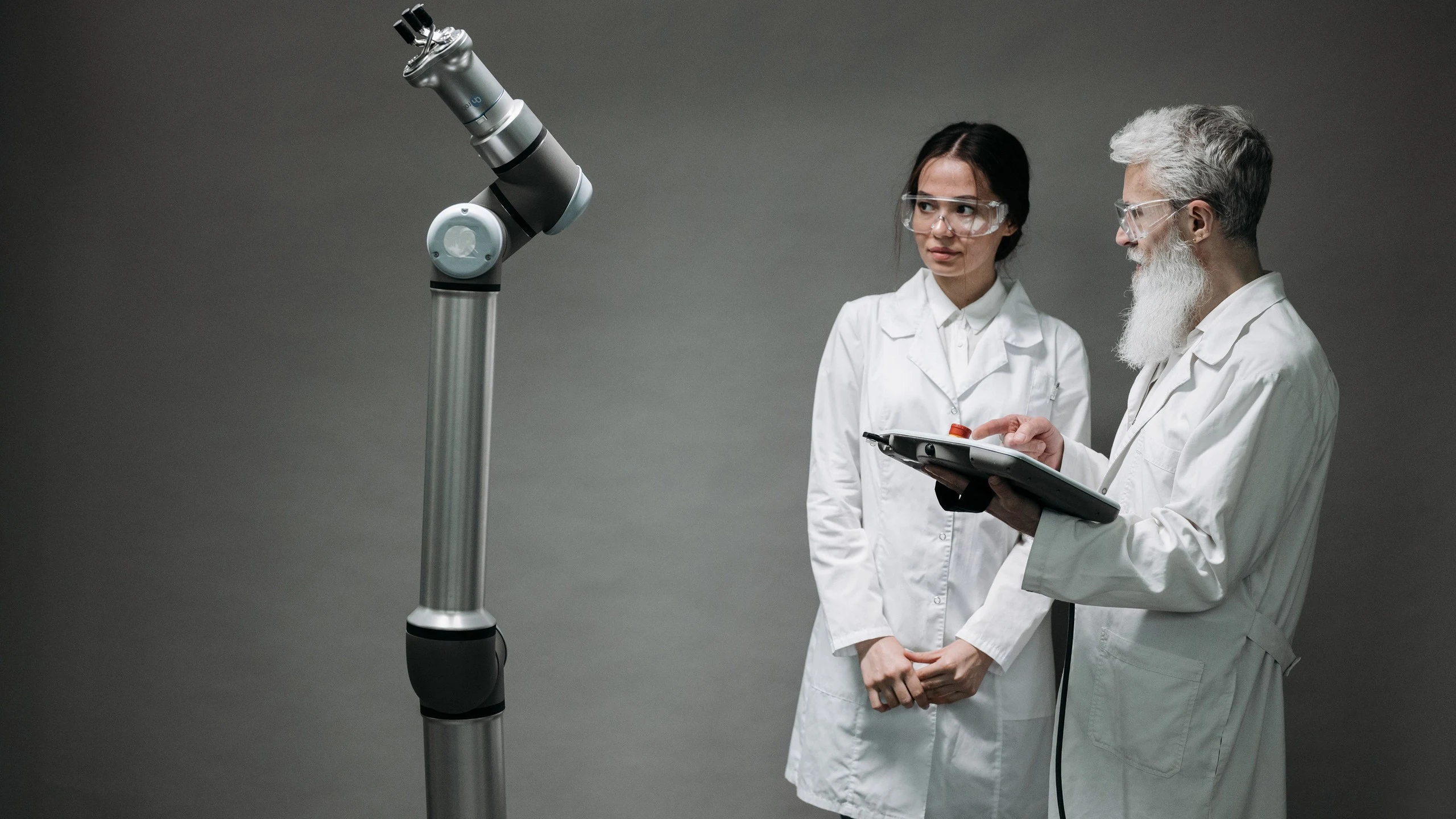
Two researchers in lab coats stand beside a robotic arm, with one holding a tablet.

Mission and Scope

Our mission is to develop and evaluate methods that connect physical observations with useful industrial decisions and appropriately authorized action. We aim to make the evidence behind those methods clear enough for engineers, researchers, and industrial partners to assess. This is a research objective, not a claim that every proposed capability has been achieved.

Aperture Physical AI Research Labs focuses on applied questions involving equipment, processes, materials, infrastructure, and mobile systems. The work begins with a physical task and the uncertainty that prevents a well supported decision. A model, sensor, or interface is examined in relation to that task rather than treated as an outcome by itself.

Define What The Research Should Explain

Industrial AI research can ask whether observations describe the right asset, whether a diagnosis is supported, whether a proposed decision satisfies the relevant constraints, or whether a physical response accomplished the intended task. Different questions require different references, comparisons, and responsibilities.

A maintenance recommendation, for example, might help a person choose an inspection. That study would need evidence about the observations, confirmed findings, review effort, and usefulness of the recommendation. It would not automatically establish authority to control equipment or a financial return from a later deployment.

Connect AIoT With Physical Action

In the Aperture architecture, AIoT connects identification, sensing, and AI decisions. Physical AI adds a Physical AI Action Engine and feedback about the resulting physical state. An alert or work order can coordinate a response, while evidence of physical completion establishes what actually changed.

The research scope includes robots, drones, and autonomous vehicles alongside connected industrial equipment. The appropriate task boundary depends on the platform, observations, interfaces, people, and operating conditions. AI and superintelligence are not interchangeable descriptions of this work.

Preserve The Boundaries Between Programs

Scientific ownership

The eight programs divide responsibility for measurement, diagnosis, decision methods, simulation, robotic behavior, assurance, security, and the learning lifecycle. Shared projects can connect those contributions, but their records should still identify who owns the method and evidence at each interface.

Scope of this hub

This website owns shared research methods, introductory knowledge, and records of work that crosses programs. Specialist sites own detailed program research. A summary here should lead readers to the relevant owner instead of creating competing versions of the same experiment or result.

A website directory is not a facilities inventory

The eight specialist websites describe complementary research scopes. Their presence does not establish eight physical laboratories, separate legal entities, or a uniform level of experimental capability. Facilities, equipment, and affiliations require their own approved descriptions.

Match The Claim To The Evidence

We aim to distinguish proposed work, work in progress, defined testbed demonstrations, supervised pilots, and deployment for a specified use. A study should report its baseline, reference evidence, sample scope, relevant failures, and uncertainty. A favorable result under one configuration does not establish performance across every machine, site, or operating regime.

Digital testing can make assumptions and sensitivity visible before a physical experiment. It cannot remove the need to examine physical observations when the claim depends on them. Human review, security, and engineered equipment responsibilities also remain part of the actual setting rather than being resolved by a model score.

Use Research To Inform A Bounded Next Step


An informative result can support continued investigation, revision, a narrower use, or an end to the work. Broader release requires suitable evaluation and assigned responsibilities. The mission is to improve the quality of those decisions through assessable research, with goals, observed findings, and expected benefits kept separate.

Scroll to Top